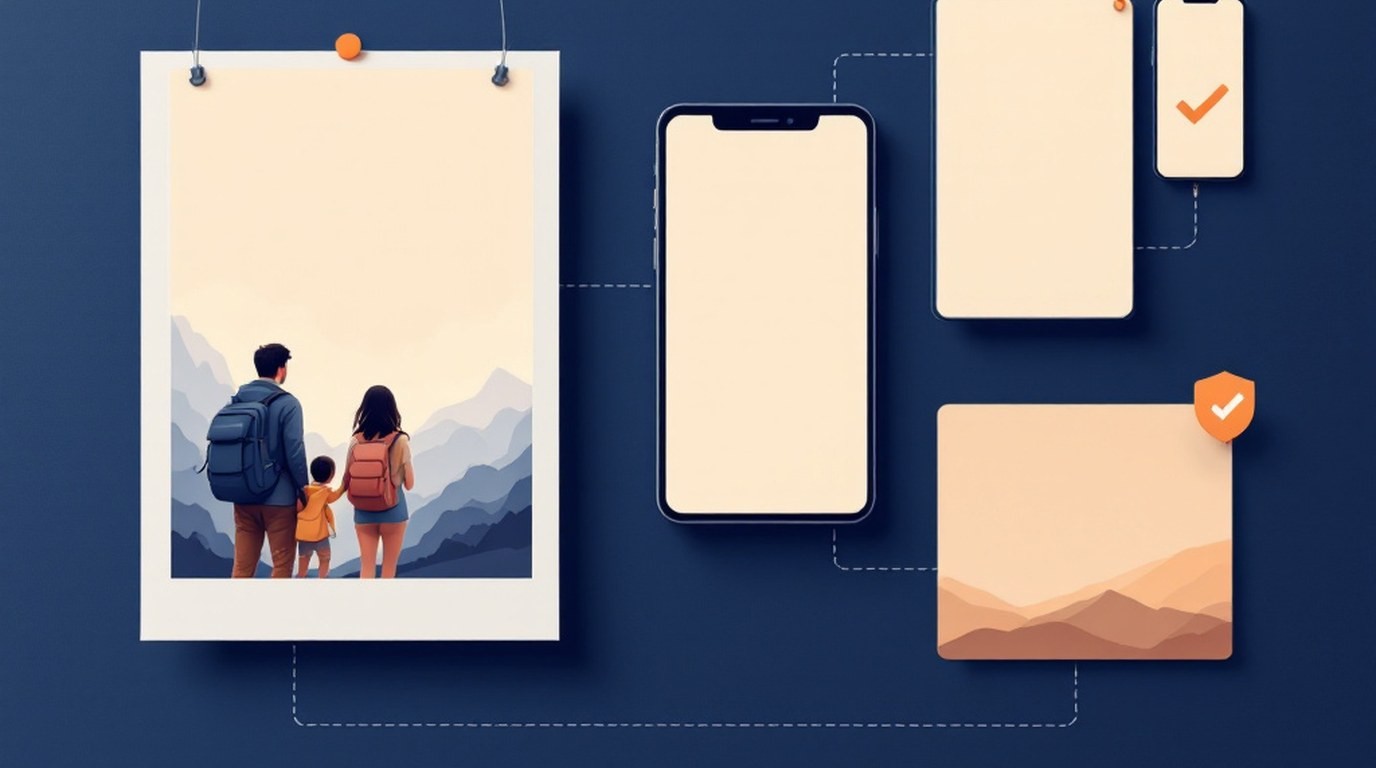
We built the campaign in this article ourselves, for a fictional brand called Leapbuzz Insurance, so we could show the exact failure points instead of describing them. Every image below is an illustrative AI-generated demo, and Leapbuzz Insurance is not a real product.
What insurance ad creation with AI actually involves
Insurance ad creation with AI is now genuinely fast. You can generate a full campaign across video, social, and display in an afternoon, for a few dollars. The hard part is not the pixels. It is two things almost nobody plans for: keeping one character consistent across every frame, still the hardest unsolved problem in AI production, and clearing the two separate rule layers that govern a regulated financial promotion.
This guide breaks insurance ad creation with AI into four parts:
- Process: the production workflow that keeps a character and a scene consistent.
- Tools: which AI image, video, and ad models earn their place, and where each breaks.
- Formats: the messaging, imagery, colour, and CTA specs per surface.
- Rules: the two compliance layers, mapped across Singapore, the US, Canada, Australia, and Malaysia.
Live demo campaign · human-strategised, generated with AI
The campaign we built: one brand, six ad sets
Before the how-to, the work itself. One fictional brand, Leapbuzz Insurance, taken through a full campaign by our production workflow: automated pipeline, human strategist at every gate. Strategy, creative judgment and business context stay human. The generation is what got fast. What you see below is Version 2 out of that system.
Each of the three creative styles runs both campaign jobs, brand and always-on sales. Six sets, thirty-six placements. Photoreal carries the emotional weight. The comic strip owns a repeatable world. Sunny the tortoise is the distinctive asset a brand could run for a decade. Every image is generated from one locked anchor per style, with every layout a real type layer set over it, no AI-rendered text anywhere. Copy, claims and disclosures were written against a per-product legal blueprint before any image existed. The tables after the galleries show that discipline working.
Photoreal
"Less drama. More trip."
One locked anchor, twelve placements, both campaign jobs.
Campaign brief
Travel cover for families across five markets. The brand job: make the mishap relatable and the brand calm. The BAU job: convert quote intent on travel head terms.
Communication strategy
Deadpan realism. The mishap is shown, the outcome is never promised: a lost bag, a closed gate, a clinic run. Loss aversion does the pulling (Kahneman); the calm resolves to the brand.
How it was made
One anchor cast, five film-look scenes, every layout set in the brand type over a navy panel. The disclosure names the people as AI-generated on every unit, because photoreal humans are this category's biggest legal landmine.
Brand campaign · Less drama. More trip.
Sales, always-on (BAU) · Covered in minutes.
Comic strip
"Every trip goes a bit sideways."
One locked anchor, twelve placements, both campaign jobs.
Campaign brief
The same product in an ownable illustrated world. The brand job: own the idea that every trip goes a bit sideways. The BAU job: sell the ten-minute app claim.
Communication strategy
Warm, dry humour. A strip world tolerates repetition without wearing out, so one idea can run all year, and the odd-one-out style gets remembered (Von Restorff).
How it was made
One style-anchor panel; new scenes generated against it with an instruction-editing model so cast, line weight and palette hold. Type is set on cream, never over the art.
Brand campaign · Every trip goes a bit sideways.
Sales, always-on (BAU) · Sorted in the app.
Mascot
"Travel unbothered." (Sunny)
One locked anchor, twelve placements, both campaign jobs.
Campaign brief
Sunny the tortoise as the fluent device. The brand job: distinctiveness and affection. The BAU job: Sunny fronts the Auto line, where the head terms live.
Communication strategy
A fluent device compounds: one character, every placement, instantly attributable (Ehrenberg-Bass). The register stays unbothered: he carries his house and packed his cover.
How it was made
Sunny locked from one source image; new poses generated, then corrected back to model where they drifted. The correction pass is a normal line item, budget for it.
Brand campaign · Travel unbothered.
Sales, always-on (BAU) · Ask Sunny.
Scroll a row sideways or use the arrows. Tap any ad to enlarge; inside the lightbox the arrow keys move between placements.
Each surface optimized for what it rewards
The set above is not one ad resized eleven times. Each platform gets the lever it actually rewards, which is the difference between a format export and a media plan.
| Platform | Funnel job | Primary lever | Measured by |
|---|---|---|---|
| Meta / Instagram feed | Brand reach + retargeting | Thumb-stop creative, broad signal | Brand lift; CPA on retarget |
| Reels / TikTok | Brand reach | First-two-seconds hook | Hold rate, cost per view |
| Trust halo | Audience precision | CTR, lead quality | |
| Google Search | Demand capture | Head-term relevance, RSA asset coverage | Quote starts, impression share |
| Display | Retargeting, frequency | Message match, frequency caps | Assisted conversions |
| Native | Consideration | Editorial-shaped headline | CTR × downstream engagement |
Search head terms follow the buyer's language per market. In Singapore and Malaysia that means "car insurance" leads the auto line, with "motor insurance" supporting; the RSA set splits quote-intent, research-intent and brand queries into separate tiers.
No claim ships without a blueprint row
Before a line of copy was written, each product got a small legal blueprint: what is sayable, on what condition, and what never ships. Every headline above maps to a row. This is the Layer B discipline from the rules section, running in production.
| Claim family | Sayable? | The rule we wrote against |
|---|---|---|
| Speed of quote ("in minutes") | Yes | Process claim, kept literal: the quote is fast, not the payout. |
| Coverage scope (lost bag, delay, clinic) | Yes | Named as covered events, never as promised outcomes. |
| "Always covered" brand voice | Brand register only | Never placed beside a product claim where it could read as scope. |
| No-claim discount protection | Yes, qualified | The "after one at-fault claim" condition sits in the ad body, not fine print (the RG 234 standard). |
| Payout certainty, testimonials | Never | Fabricated or synthetic testimonials are the #1 AI ad violation (FTC 16 CFR 465). |
| Prices, premiums, comparisons | Never | Pricing belongs in the quote flow, not a static demo ad. |
Screened against five markets before anything shipped
Every unit above was checked against the researched rule set for the markets this guide covers. It is the same two-layer screen the rules section explains. Green cleared for this demo set. Grey means the rule bites at live-deployment time or is pending a primary-source verification, so it gets a case-by-case pass.
The per-market screen
Cleared for this setCase-by-case at deployment
Photoreal units carry the AI-people disclosure in the artwork itself.
No testimonials anywhere in the set, real or synthetic. The blueprint marks them Never.
Process claims kept literal: quote speed and covered events, never outcomes.
Disclosure is carried. The statute citation is pending primary-source verification.
A carrier-operations rule. It bites at insurer deployment, not demo creative.
Coverage named as events, not promised outcomes; no misleading representation.
Applies at media-buy targeting time, where a demo exercises no personal data.
Copy clears the misleading tests. A live AU run adds the balanced-risk line per placement.
No false or unbalanced product representation; the fictional brand is disclosed.
No protection-scheme references, no misleading representation.
A live campaign gets a per-market legal pass before trafficking. This screen is production discipline, not legal advice.
One point we want to be plain about. The images above are AI-generated, and the first drafts came out of the models in an afternoon. What you see, though, is step-two output: the copy was written against the legal blueprint first, the layouts are a design system with a human-controlled type layer, and a third of the generated images needed a correction pass before the characters held. Fast generation plus a crafted layer on top is the honest shape of this workflow.
Every one of these still has to run a human review loop before it goes anywhere near a live buy, for creative improvement, brand and message alignment, and the two compliance layers this guide walks through. The automation gets you a strong first draft in an afternoon. The human pass is what makes it correct, on-brand, and legal to run. For enterprise clients in regulated industries that human layer is not a stopgap while the models improve; it is the product. Treat the AI as the fast first mile, not the finish line.
Four lessons stood out, and they are the parts a vendor demo will not tell you:
- Character consistency is the real bottleneck. Budget a correction pass or art-direct around it.
- Humour beats fear. Our early fear-led script read as cheap. A dry, confident script that admitted travel always goes a bit wrong landed far better, and modern insurance advertising rewards it.
- Realistic AI people are the biggest compliance risk you can add. The better they look, the closer they sit to a fake testimonial.
- Strong static formats beat a weak fake-video. If you cannot afford proper full motion, do not fake it with panned stills.
Process: lock the character first, animate second
The single most useful thing we learned: never ask a video model to invent a face. Lock the identity in a still image, get it approved, then animate that still. Studios run the same two-stage pattern.
The workflow that held up:
- Write the character in words, then generate a character sheet (a clear group or portrait reference) with a consistency-capable image model, seed held steady.
- Approve one or two canonical reference images. This is your anchor.
- For every scene, generate from the anchor as a reference input plus a scene instruction, so the same face carries across shots.
- Review each scene against the anchor before it goes anywhere. Reject drift early.
- Animate each approved still with an image-to-video model, where the start frame is the locked character.
- For a recurring brand character used across many campaigns, training a lightweight character model on ten to twenty images buys far tighter identity than prompting alone.
The honest warning, from our own build: even with a reference image, current models hold resemblance, not perfect identity, across very different scenes and lighting. Our father character drifted between shots, and one sunlit beach frame changed his hair colour entirely until we forced it back. Character consistency is the hardest unsolved problem in AI ad production right now. It does not fix itself later in the pipeline, because the video inherits whatever the still gave it.
Plan for a correction pass. Or art-direct around the problem with wider shots, backs of heads, and angles where an exact face match matters less.
Tools: what earns its place, and where each breaks
A few practical truths that save money and rework.
Legible in-image text is a narrow capability. Only a couple of image models render clean headlines and a CTA reliably inside the picture. For everything else, generate the imagery clean and add the text as a real type layer afterwards. This one decision removes most of the garbled-text look that flags an ad as AI-made.
Licensing is a real filter for a regulated brand. Image models differ sharply on commercial-use and indemnity terms. For a conservative insurer, that matters more than a small quality edge. Confirm the licence of any model before it touches client work. Treat model terms pages as the source of truth, not a forum post.
Video is a two-stage tool, not a one-shot. The reliable path is a consistency-locked still animated by an image-to-video model, with the start frame carrying the character. Text-to-video from scratch is where identity and physics fall apart.
Realistic AI people are the sharpest double-edged tool in this stack. They are now good enough to pass at a glance, which is exactly why they are the number one legal landmine below. If your ad needs a "customer," a realistic synthetic person is the riskiest possible choice.
We also hit a real production wall worth flagging. Our still-based, slowly-panned video cut looked flat and boring next to actual motion. Proper full-motion needs a generated clip per scene, which multiplies cost and makes the consistency problem worse. For many insurance campaigns, a set of strong static formats built from photoreal stills outperforms a weak "video" assembled from stills. Choose the format the budget can actually execute well.
Formats: messaging, imagery, colour, CTA, and the specs
Different surfaces reward different craft. The dimensions below are the stable production sizes.
Video (16:9 and 9:16)
- Landscape 1920x1080 for YouTube and connected TV; vertical 1080x1920 for Reels, Shorts, and TikTok; square 1080x1080 for feed.
- Hook in the first three seconds, because most pre-roll is skippable at five. Open on the tension the product resolves, not the logo.
- Assume muted viewing. Every frame has to work with text on screen, because a large share of short-form video plays without sound.
- Close on a single, plain CTA that describes an action, never a guaranteed outcome.
Display and banner (IAB standard sizes)
| Format | Pixels | Primary placement |
|---|---|---|
| Medium Rectangle | 300x250 | The workhorse. Design this one first. |
| Leaderboard | 728x90 | Desktop top-of-page and article header. |
| Half Page | 300x600 | High-impact sidebar with real dwell time. |
| Wide Skyscraper | 160x600 | Desktop right rail. |
| Mobile Banner | 320x50 | Mobile header and footer. |
- Headline text large enough to read at small sizes, brand logo in a consistent corner, one contrasting CTA button.
- Prefer real fonts for the text layer, so the copy stays crisp and on brand.
- Vertical units earn dwell, so they can tell a small problem-to-solution story across the height.
Social feed (1:1, 4:5, Stories 9:16)
| Format | Dimensions | Where |
|---|---|---|
| Square | 1080x1080 | Meta and LinkedIn feed |
| Portrait | 1080x1350 | Instagram feed, highest coverage |
| Stories and Reels | 1080x1920 | Stories, Reels, TikTok, Shorts |
- Warm, human photography beats isolated product shots. Keep in-image text minimal and let the caption carry the detail.
- Keep interactive stickers and CTAs inside the centre safe zone so platform chrome does not clip them.
Colour and tone for insurance
Trust palettes lean navy, deep green, white, and grey; approachable challenger brands lean warm amber and soft terracotta. Avoid high-saturation red, which reads as alarm, and heavy black, which can carry a morbid tone in some markets. For our travel demo we ran a deep navy with a warm amber accent, held consistent across the video, social, and banner cuts.
CTA language: describe the action, never promise the outcome
| Use | Safe phrasing | Avoid |
|---|---|---|
| Quote | Get a quote, Compare plans, See your options | Lowest rate guaranteed, Cheapest cover |
| Info | Learn more, See how it works | Any false urgency, Act now, Only a few left |
| Apply | Start your application, Get covered in minutes | Instant approval, Guaranteed cover |
Artificial scarcity, countdown timers and "only a few spots left", is inadvisable for insurance in regulated markets, because advertising that does not reflect real conditions misleads. The exception is a genuine time window, such as an open-enrolment period.
Rules: the two layers that actually decide if you can run it
Here is the frame most teams miss. There are two separate rule layers, and they are orthogonal. A perfectly AI-labelled ad can still be illegal under the pre-existing financial-promotion rules, and AI makes the two worst violations cheaper to commit.
Layer A: does the ad have to be labelled as AI-made?
This is real and recent. Verified from primary sources:
| Fact | Value | Status |
|---|---|---|
| EU AI Act Article 50 transparency in force | 2 August 2026 | Verified |
| California SB 942 operative date (moved by AB 853) | 2 August 2026 | Verified |
| California hosting-platform obligation | from 1 January 2027 | Verified |
| New York Synthetic Performer disclosure | reported June 2026, confirm before relying | Needs caveat |
| US FTC fake-reviews rule (16 CFR 465) | effective 21 October 2024 | Verified |
| Australia ASIC RG 234, republished with AI provisions | 9 June 2026 | Verified |
| Singapore, Malaysia, Australia, Canada mandatory AI labelling | none yet, voluntary guidance | Verified |
The correction most guides get wrong: only the EU and specific US states currently force an AI label on the ad itself. Singapore, Malaysia, Australia, and Canada rely on voluntary frameworks today. Do not imply otherwise.
Layer B: the insurance rules that bite regardless of AI
Every market already governs how a financial product can be advertised, and those rules reach AI creative untouched. This is the per-market spine of the whole thing.
| Market | Run AI creative? | Must label as AI? | Key insurance-ad constraints |
|---|---|---|---|
| Singapore | Yes | No mandate, voluntary framework | MAS financial-advertising rules against false or misleading representation |
| USA | Yes | No general federal label; NY covers synthetic performers | FTC section 5 and 16 CFR 465 on fake testimonials, state insurance-department ad rules, NAIC AI model bulletin |
| Canada | Yes | No federal mandate; Quebec Law 25 on automated decisions | Provincial conduct rules, CCIR and CISRO fair-treatment, OSFI model-governance guidance |
| Australia | Yes | No mandate, guardrails were not adopted | ASIC RG 234, which now names AI-generated advertising and hallucination risk, plus the AANA code |
| Malaysia | Yes | No mandate, national guidelines are voluntary | Bank Negara Malaysia market-conduct rules on misleading representation, PIDM protection-representation rules |
Where AI creative raises the risk, ranked
- Synthetic customers as fake testimonials. A generated face plus a generated quote that reads as a real customer is a fake testimonial. It is hit directly by the US fake-reviews rule, the endorsement guides, the New York synthetic-performer rule, and every market's misleading-representation law. This is the number one landmine.
- Unrealistic outcome imagery. AI pictures that imply a guaranteed payout or an effortless claim breach balanced-presentation duties. Australia's ASIC RG 234 names hallucinated and biased AI content explicitly.
- Hallucinated coverage or benefit claims. AI copy that invents a coverage term or a statistic is a false representation about a financial product, load-bearing under every regime.
Can I ship this AI creative here?
How leapbuzz works this
What you see above is what the operating system looks like when it is built properly. A locked brand and character reference, copy written against a legal blueprint before generation, a per-market compliance screen wired into the production step rather than bolted on after, and a human strategist making the calls at every gate. The generation got fast. The strategy and the business context did not stop being human work. For enterprise clients in regulated industries, that is the point, not a caveat.
The campaign above is Version 2 out of that system. If you are weighing AI creative for an insurance brand, the question is not whether the models can draw. It is where the human judgment sits in your production line. That is the conversation to have with us.
For the adjacent detail, see our deeper pieces on compliant video advertising for insurance, the Aug 2 AI-disclosure rules, and what Meta Advantage+ Creative does to your ads, and our insurance marketing practice.