Why insurance martech is uniquely hard
The standard martech pitch assumes your customer data lives in the CRM. For most businesses that is roughly true: e-commerce orders, SaaS subscriptions, and B2B sales cycles all generate events that can flow through a CRM with modest integration work. Insurance is different because the most important data, which is the policy itself, lives in a policy-administration system that predates most modern martech platforms and was built for underwriting, billing, and claims, not for marketing.
That architecture mismatch creates a chain of problems that generic martech advice does not address. The insurer knows a policyholder renewed last month, but that event is in the policy-admin system. The CRM knows the policyholder's email address and consent record, but it has not received the renewal event. The email platform fires a generic renewal reminder to a policyholder who already renewed three weeks ago. This is not a targeting failure; it is a data-connectivity failure, and it repeats across every touchpoint: mid-term cross-sell, lapse win-back, claims follow-up.
Three factors make insurance martech harder than most sectors:
- Long policy lifecycles with few natural touchpoints. A car insurance policy renews annually. A life policy may run 20 years. Between the sale and the renewal there are few natural moments when the policyholder engages with the product, which means mid-term marketing has to create reasons to engage, not just respond to existing engagement signals.
- Regulated data handling at every layer. Policyholder data is personally identifiable and, in health and life lines, sensitive. Every platform in the stack that touches that data is a compliance surface: which jurisdiction's rules apply, whether the platform is a material outsourcing arrangement under the local regulator's guidance, and what happens to the data if the contract ends.
- Consent obligations that differ by message type and market. A renewal notice is a servicing communication and runs on the existing contract in most markets. A renewal offer with an upgrade or cross-sell is marketing and requires a separate consent basis. Running both through the same code path is the most common compliance failure in insurance outbound programmes. The stack has to track consent type per communication, not just per contact.
The five layers of the insurance martech stack
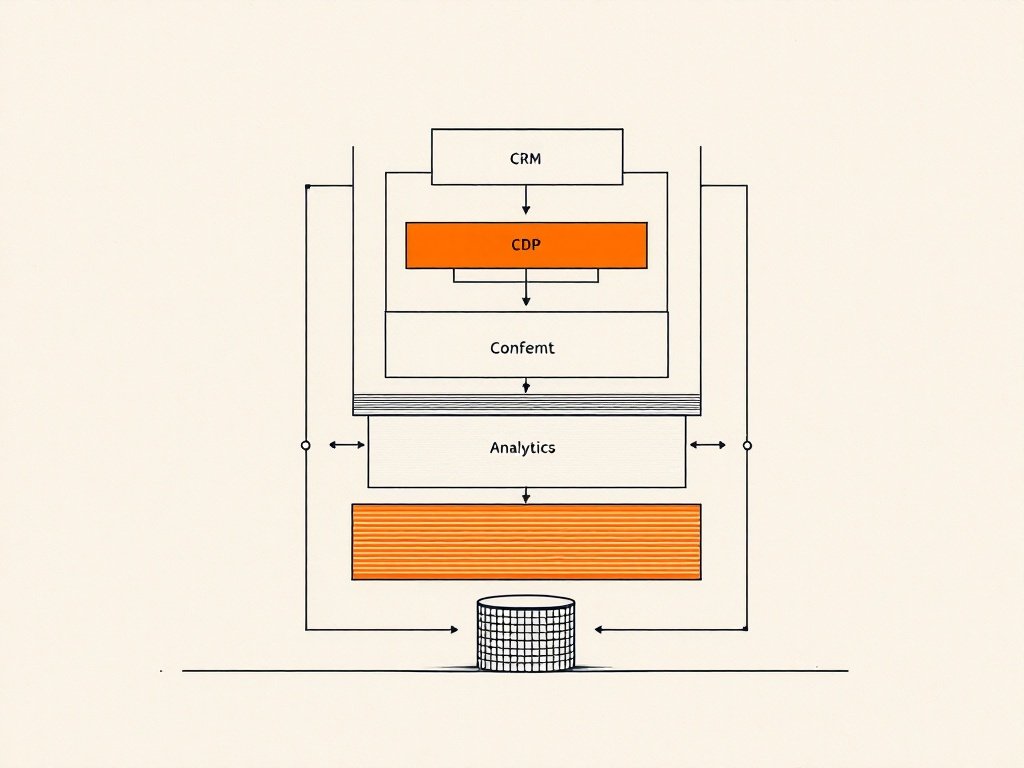
A complete insurance marketing technology stack has five layers. Not every insurer needs to buy all five as separate platforms; some CRMs absorb functions from adjacent layers, and some insurers have enough data maturity to skip the CDP. But every function in all five layers needs to be handled somewhere. The question is which platform carries it and whether the hand-offs between platforms are clean.
Layer 1 | Foundation
CRM: the contact and relationship record
The CRM holds the contact record, the consent record, and the relationship history. In insurance, the relationship history has to include at minimum: policies held, renewal dates, claims history (at least whether a claim was filed and its status), payment behaviour, and service contact history. A CRM that holds only email address and opt-in status is a contact list, not a CRM. The integration that makes a CRM useful in insurance is the policy-admin feed: a near-real-time sync of policy events into the CRM so the contact record reflects the current state of the policyholder relationship.
Common platforms at this layer: Salesforce Financial Services Cloud HubSpot Microsoft Dynamics 365 Zoho CRM. Carrier-specific: Applied Epic Guidewire (which has CRM modules alongside its core policy-admin and claims functions).
Layer 2 | Identity unification
CDP: one identity across systems
A Customer Data Platform (CDP) builds a unified, persistent identity from multiple source systems and makes that identity available to every downstream tool via API. In insurance, the sources are the policy-admin system, the CRM, the website and app (behaviour data), and the consent management system. The CDP does not replace any of them; it resolves the identity across them so that when the email platform wants to send to "policyholder 2847", it gets a single deduplicated record with current consent status, current policy state, and current engagement signals, not three partially-overlapping records from three systems.
This layer is optional for single-market insurers with one policy-admin system and a well-integrated CRM. It becomes necessary when cross-system identity resolution cannot be done in the CRM alone.
Common platforms: Segment (Twilio) mParticle Tealium AudienceStream Bloomreach. Warehouse-native alternative: dbt plus reverse ETL via Hightouch or Census if the insurer already has a data warehouse.
Layer 3 | Execution
Marketing automation: the rules and journey engine
Marketing automation handles who gets which message, on which channel, on which trigger, subject to which consent check. In insurance the core journeys are renewal outreach (starting 90 days before expiry), mid-term engagement (claims-related touches, benefit reminders, document nudges), cross-sell sequences (for policyholders who qualify for adjacent products), and lapse win-back (30 days post-lapse maximum window). The automation platform executes these journeys; it does not design them. Journey design is the prior step, done by people who understand both the policy lifecycle and the consent rules per market.
Common platforms: Braze Iterable Salesforce Marketing Cloud HubSpot Marketing Hub Klaviyo (for direct-to-consumer personal lines). Channel coverage matters: the platform should handle email, SMS, push notifications, and in-app messaging from a single journey canvas, not require a separate tool per channel.
Layer 4 | Compliance
Consent and preference management: the legal gate
Consent management records the legal basis for each communication type, per channel, per jurisdiction, per contact. Preference management records how the contact wants to be reached. Both need to travel to every channel tool before a send. In a single-market insurer with one product line, this can live in the CRM. In a multi-market insurer with both servicing and marketing communication types, it needs a dedicated consent store with a single API that every channel tool reads before sending. The consent record and the policy record must be in sync: a policyholder who cancels their policy and withdraws consent at cancellation must be suppressed from win-back sequences before the next send cycle.
Common platforms: OneTrust TrustArc Didomi Usercentrics. Many insurers manage consent inside the CRM or the automation platform for simpler single-market operations, which works until consent is collected at multiple touchpoints across multiple systems.
Layer 5 | Measurement
Analytics: marketing performance and policyholder journey
The analytics layer has two distinct jobs that are often conflated. Marketing performance measurement covers campaign attribution, cost per bound policy, cost per renewal, return on ad spend by channel and product line, and incrementality testing. Policyholder journey analysis covers activation (first meaningful engagement post-purchase), mid-term engagement signals, and churn precursors. These two jobs require different data: marketing performance needs paid-media event data joined to policy-bind events; policyholder journey analysis needs policy-admin events joined to digital behaviour. The connection between them, policy-level events informing campaign optimisation, is where most insurers have a gap.
Common tools: GA4 or server-side analytics for web attribution; Looker Metabase Tableau for dashboard reporting; a data warehouse (BigQuery Snowflake) for joining policy and marketing data. The Marketing Mix Modelling (MMM) layer sits here too for insurers at sufficient scale to run econometric channel measurement.
| Layer | Function | When it is necessary | When it can be simplified |
|---|---|---|---|
| CRM | Contact + relationship record | Always | Policy-admin system has its own contact module with marketing integration |
| CDP | Cross-system identity unification | Multiple policy-admin systems, multiple markets, or web+offline unification needed | Single market, one policy-admin system, CRM well-integrated |
| Marketing automation | Journey execution + channel routing | Always for anything beyond manual batch emails | Very small insurer with one channel (email only) |
| Consent management | Legal basis per contact per channel | Multiple markets with different consent rules; consent collected at multiple touchpoints | Single market, consent managed in CRM |
| Analytics | Performance + policyholder journey measurement | Always | No simplification available; both measurement jobs must be done somewhere |
The CRM-versus-CDP question
The most common decision point in insurance martech design is whether a Customer Data Platform (CDP) is needed alongside the CRM or whether the CRM can carry the identity-unification job. The honest answer is that it depends on one specific question: can the insurer get a clean, deduplicated, consent-current identity from the CRM alone?
If the answer is yes, the CDP is overhead. A CRM that receives policy events via a well-built integration from the policy-admin system, holds the consent record, and pushes clean profiles to the automation platform is sufficient for most single-market personal lines operators.
If the answer is no, the CDP is the fix. The no scenarios are common in insurance:
Multiple policy-admin systems
A carrier that grew by acquisition may run three separate policy-admin systems, each with its own contact records. The CRM has partial information from each. The CDP resolves the overlapping identities and produces one record per real-world policyholder, with the correct consent status sourced from the most recent consent event across all systems.
Online and offline data that needs unification
Web behaviour (quote abandoned, policy document downloaded, claims FAQ read) is digital. Policy behaviour (renewal paid, mid-term endorsement added) is in the policy-admin system. Joining them in the CRM requires a custom integration that most CRM implementations do not have. A CDP connects both sources and makes the unified profile available downstream without rebuilding the join logic in every channel tool.
Multiple markets with different consent schemas
An insurer operating in Singapore (PDPA), Australia (Privacy Act), Canada (CASL), and the US (CAN-SPAM plus TCPA) has four consent frameworks with different rules about what constitutes valid marketing consent, how long it lasts, and what it covers. A CDP with consent federation, where each market's consent record is stored in the format that market requires but exposed through a unified API, is significantly easier to manage than four consent schemas in one CRM table.
Real-time audience push to paid media
A renewal sequence that needs to pause paid retargeting for policyholders who just renewed requires near-real-time audience suppression in Google Ads, Meta, and any programmatic DSP (Demand-Side Platform). A CDP with a real-time API can push suppression lists to those platforms as soon as the policy event fires. A CRM doing this via a scheduled export runs on a delay that can be measured in days, not minutes.
Operator note
A CDP does not replace the CRM. It resolves identities from the CRM and other sources, enriches them, and distributes them. The CRM remains the relationship management system and the sales-team interface. The CDP is the plumbing between systems, not a replacement for any of them.
For the analytics layer's role in this architecture and how it connects to channel performance, the post on neobank attribution and analytics covers the data warehouse and reverse-ETL patterns that apply equally to insurers building a measurement layer on top of their policy-admin data.
Where AI genuinely helps in the insurance martech stack, and where it adds risk
AI is being added to every layer of the martech stack by every platform vendor. Most of those features are useful at the margins. A few are genuinely load-bearing. Several create compliance risk in insurance that generic martech buyers would not encounter.
Where AI genuinely earns its place:
- Churn propensity scoring. A model trained on historical renewal outcomes, fed mid-term engagement data (open rates, claims activity, payment history, service contact frequency), can identify policyholders at risk of lapse 90 to 120 days before their renewal date. That lead time is the working window for a retention intervention. Without a propensity model, the intervention is a time-triggered blast that goes to everyone; with it, the intervention goes to the subset most likely to lapse, with a message calibrated to the likely reason. The model requires a clean mid-term data feed from the policy-admin system. If that feed does not exist, the model has nothing to score.
- Send-time optimisation. Selecting the delivery window for each contact based on their historical engagement patterns, open rates by hour and day, is a straightforward AI application that most mature automation platforms now include. For insurance, where email volume is low relative to e-commerce and attention to each message matters more, send-time optimisation has measurable impact on open rates and response rates for renewal and cross-sell sequences.
- Lookalike audience building for acquisition. A model trained on the characteristics of the insurer's best policyholders, those with low claims frequency, high renewal rates, and high lifetime value, can generate lookalike audiences for paid acquisition across Google and Meta. This is standard performance marketing practice across sectors; in insurance it requires that the training data is properly anonymised and that the audience export does not include regulated attributes (health status, claims history) that the platform's terms of service or local data protection law prohibit using for targeting.
- Anomaly detection on suppression lists and delivery data. An automation platform sending to a suppressed list, or a consent record that has not been updated after a policy cancellation, is the kind of silent failure that produces a compliance event. AI-based anomaly detection on delivery data can flag unusual open rates, unusual suppression failures, or mismatch between expected audience size and actual send volume before the compliance team finds out about it after the fact.
Where AI adds risk in insurance:
- Generating copy that makes coverage claims. Any message that describes what a policy covers, excludes, or pays out is a compliance surface in every market. AI-generated copy in that area will introduce subtle inaccuracies. The working architecture is AI that selects from a pre-approved, compliance-reviewed content library, not AI that generates copy outside it. MAS Notice FAA-N03 in Singapore, ASIC Regulatory Guide 234 in Australia, and equivalent standards in other markets set the accuracy and non-misleading standard that generated copy must meet.
- Determining consent status. Whether a specific contact can receive a specific message type on a specific channel on a given date is a compliance question, not a prediction problem. That determination comes from the source-of-truth consent record, not from a model that infers it. Any architecture that puts a model between the consent record and the send decision is creating a compliance audit trail that does not hold up.
- Personalising on regulated attributes. Health status, claims history, and coverage level are attributes that may not be used for targeting under the terms of service of major ad platforms and, in some markets, under data protection law. An AI targeting model that uses these attributes, even in an anonymised aggregate, is a legal risk that most marketing teams have not evaluated.
| AI application | Verdict | Condition |
|---|---|---|
| Churn propensity scoring | High value | Requires mid-term data feed from policy-admin system |
| Send-time optimisation | High value | Standard feature in most mature automation platforms |
| Lookalike audience building | High value | Must exclude regulated attributes from training data |
| Anomaly detection on delivery data | High value | Useful compliance safeguard, not widely deployed yet |
| AI-generated coverage copy | Risk | Must not generate outside a compliance-reviewed content library |
| AI-determined consent status | Hard no | Consent determination is a compliance record, not a model output |
| Targeting on health or claims data | Risk | Check platform ToS and local data protection law per jurisdiction |
For a broader view of how AI tools are being adopted in regulated-sector marketing programmes, the AI strategy service page covers the governance model leapbuzz applies across the full engagement.
The data-governance and compliance spine that runs through every layer
The five-layer stack is the structure. The data governance framework is what makes it legally operable. Every platform in the stack that touches personally identifiable policyholder data is a compliance surface. The governance framework answers four questions for each platform: what data does it hold, what does it do with that data, what is the legal basis for that use, and what happens to the data if the contract ends.
The compliance rules are not uniform across the five target markets. Here is how the key obligations land for insurance martech deployments:
Singapore
The Personal Data Protection Act 2012 (PDPA) governs collection, use, and disclosure of personal data. For direct marketing, PDPA Part IX and the Do Not Call (DNC) registry provisions apply: marketing messages by voice call, SMS, or fax to DNC-registered numbers require clear and unambiguous consent unless the contact gave valid consent before registering. MAS Outsourcing Guidelines require that material outsourcing arrangements, which enterprise martech SaaS typically qualifies as, be assessed for data residency, audit rights, and exit provisions. A martech deployment touching Singapore-resident policyholder data without a documented PDPA impact assessment and MAS outsourcing review is a compliance gap.
Malaysia
Malaysia's PDPA 2010 requires that data subjects can opt out of direct marketing at the point of collection and in every subsequent marketing message. Bank Negara Malaysia (BNM)'s Fair Treatment of Financial Consumers (FTFC) policy requires clear, accurate, and not-misleading product information in renewal and marketing communications. For takaful operators, lexical compliance is also required: contribution not premium, certificate not policy, covered person not insured. Any marketing platform running communications across both conventional and takaful books needs separate message templates per product type, not a single template with a terminology variable.
Australia
The Spam Act 2003 requires express or inferred consent for commercial electronic messages. An existing customer relationship provides inferred consent for messages directly related to that relationship; a renewal reminder for the product held qualifies, a cross-sell offer does not. The Privacy Act 1988 applies to personal data handling broadly. ASIC Regulatory Guide 234 sets the standard for insurance promotional material: accurate, clear, concise, and not likely to lead to a false impression. Unsubscribes from email marketing must be processed within five business days under the Spam Act.
United States
CAN-SPAM governs commercial email and does not require prior consent but mandates opt-outs be honoured within ten business days. The Telephone Consumer Protection Act (TCPA) is the harder constraint for SMS: prior express written consent is required before sending marketing texts to cell numbers using an automated dialing system. Renewal SMS programs that stay strictly within policy administration facts may qualify for a TCPA safe harbour; any promotional element moves them into marketing territory and requires prior written consent. State-level insurance advertising codes, based on NAIC model regulations, apply to promotional content standards.
Canada
Canada's Anti-Spam Legislation (CASL) is the most prescriptive in the group. Express consent is required for commercial electronic messages unless implied consent applies. Implied consent from an existing customer relationship is time-limited: generally two years from the last transaction. A lapsed policyholder beyond the two-year window requires documented express consent. Quebec adds a language obligation: French-language materials must be available and must generally be the default for Quebec residents under the Charter of the French Language.
Compliance warning
A martech stack that runs a single consent flag across all five markets will miscategorise messages in at least two of them. The consent schema must be per-jurisdiction, and the suppression logic must apply the most restrictive applicable rule per recipient, not the most permissive. Auditing this after a campaign has sent is a much worse position than designing it correctly before the first send.
For deeper coverage of how compliance rules apply to specific outreach programmes, the insurance renewal marketing automation post covers the five-market consent framework at the per-stage level of a renewal programme.
A stack-assembly framework for insurance operators
The right sequence for building or rebuilding an insurance martech stack is infrastructure first, then programmes, then optimisation. Adding AI or advanced personalisation before the data infrastructure is sound is the most expensive mistake insurers make in martech, because it accelerates non-compliant sends, not compliant ones.
The framework has four phases:
- Audit the data infrastructure. Map what the policy-admin system exposes via API or scheduled export, what the CRM currently receives, what events are missing or delayed, and where the consent records live. This audit determines whether a CDP is needed and what integration work is required before any programme can run cleanly.
- Fix the consent architecture. Before running any marketing programme, confirm that consent records are current, correctly categorised (servicing versus marketing), and flowing to every channel tool. This means auditing the consent record in the CRM against the policy-admin system's last known contact, checking whether DNC and opt-out processing is working across all channels, and verifying that suppression lists are being applied before sends, not after.
- Build the programmes on clean data. With the data infrastructure and consent architecture in place, build the renewal sequence, the mid-term engagement programme, and the cross-sell journeys against real policy events, not time-triggered approximations. Journey design is the prior step; the automation platform executes the design.
- Add AI and advanced optimisation. Once the programmes are running on clean data and producing measurable outcomes, AI applications become useful: propensity scoring to prioritise intervention within the renewal sequence, send-time optimisation within consent-cleared pools, and lookalike audiences for acquisition campaigns. Adding these before step three means optimising a broken programme faster, which is not an improvement.
| Layer | Diagnostic question | If the answer is no |
|---|---|---|
| CRM / Data | Does the CRM receive policy events (renewals, lapses, endorsements) from the policy-admin system within 24 hours? | Integration gap. Marketing programmes run on stale data. |
| Consent | Is the consent record per contact tagged by type (servicing vs marketing) and synced to every channel tool before sends? | Compliance gap. Servicing sends are reaching marketing-only-consented contacts, or vice versa. |
| CDP / Identity | Can the insurer produce one deduplicated, consent-current record per policyholder across all source systems? | Identity fragmentation. Programmes duplicate contacts or miss them. |
| Automation | Are renewal sequences triggered by policy events (90-day pre-expiry) rather than by a scheduled batch export? | Timing failure. Some policyholders receive renewal outreach after they have already renewed or lapsed. |
| Analytics | Can the insurer measure cost per bound policy and cost per renewal by channel, not just cost per click? | Measurement gap. Channel optimisation is based on proxies, not business outcomes. |
Operator note
The stack-assembly framework above is how leapbuzz approaches insurance martech engagements across Singapore, Malaysia, Australia, the US, and Canada. The starting point is always the data audit, not the platform selection. Platform selection follows from what the data architecture requires, not from which platform is most familiar to the marketing team.
For the measurement side of this stack, particularly how to attribute policy-bind events back to paid media channels, the analytics and insights service page covers the attribution and measurement frameworks leapbuzz implements across insurance and other regulated sectors.