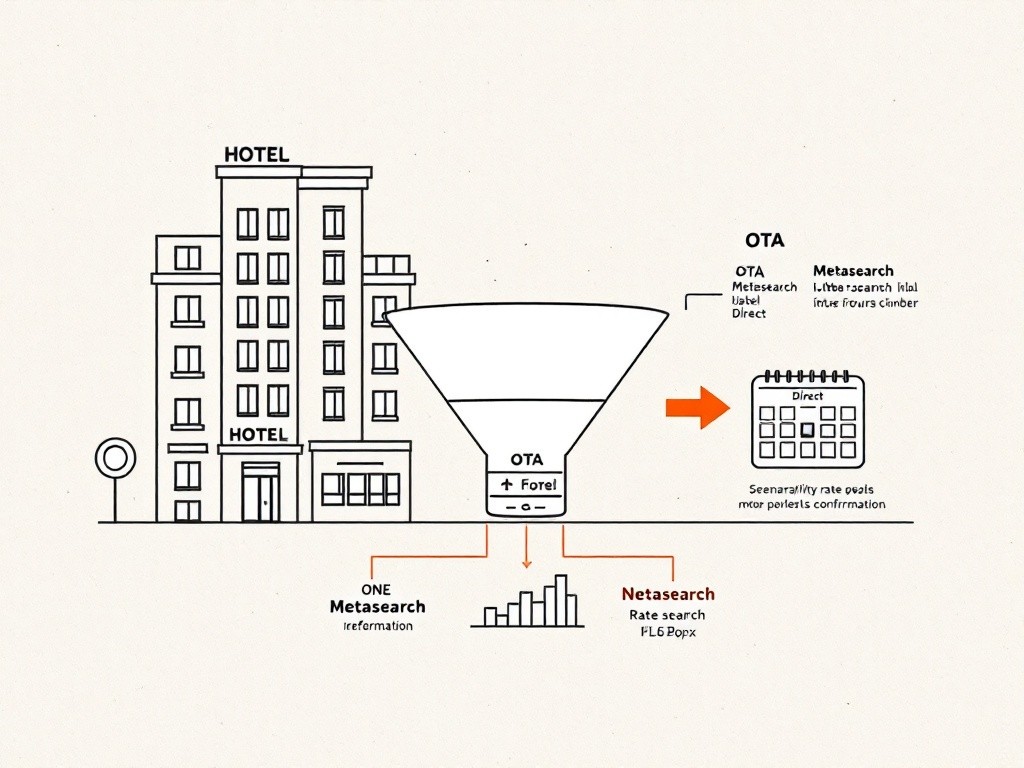
OTA-vs-direct: the commission economics that drive the paid media case
OTA commission rates in accommodation run 15% to 25% of the room rate for standard partnerships. Preferred-partner and paid-visibility programs push that toward 30%. That percentage applies to every transaction, every night, with no ceiling. For a property generating a meaningful share of its occupancy through OTA channels, the commission line is a structural cost that compounds as OTA dependency deepens.
The economic case for hotel paid media is simple: the cost of acquiring a direct booking through paid media is, for most properties with functional direct-booking infrastructure, below the OTA commission rate on the same room. Brand search campaigns typically acquire direct bookings at a fraction of what the OTA charges on the same transaction. Google Hotel Ads free booking links carry zero cost per click. Even paid Hotel Ads with a healthy cost per click commonly produce a cost per booking well inside the 15-25% commission range when the booking engine is performing.
What changes the calculation is the rate parity problem. A direct booking channel that consistently shows a higher rate than the same room on an OTA does not convert, regardless of traffic quality or media spend. The economic model only holds when the direct rate is at minimum equal to the OTA rate and, for loyalty members, demonstrably better. Rate parity is not a nice-to-have precondition; it is the prerequisite the entire paid media stack rests on.
OTA-vs-direct: where the cost difference lives
Illustrative comparison only. Actual costs vary by property, market, and channel. Media cost per acquired room night will differ from cost per click.
The second economic point is compounding. OTA dependency deepens negotiating weakness. A property generating 65% of occupancy through OTA channels has less leverage to push back on preferred-partner rate conditions, review management terms, or commission escalations than one at 35%. The direct booking investment is not purely a cost-arbitrage play; it is a structural position that improves over time as the direct share grows and the OTA dependency shrinks.
For a fuller treatment of the direct-booking economics, including an interactive calculator for modelling your commission exposure, the direct booking growth guide covers the financial model in detail. This post focuses on the paid media stack that drives that shift.
Metasearch and Google Hotel Ads: how the bid mechanics actually work
Metasearch for hotels aggregates rates from multiple sources and shows them side by side: OTAs, direct booking engines, global distribution systems (GDS), and bed banks all feed into the comparison. Google Hotel Ads is the dominant metasearch channel by traffic volume in most markets. Tripadvisor, Kayak, and Trivago also operate metasearch surfaces; the operational mechanics differ but the principle is the same.
Within Google Hotel Ads, there are two distinct participation tracks. Paid Hotel Ads: you bid on placement and pay per click when a traveller selects your rate link. Free booking links: your rate feed is connected to Hotel Center and you appear in the results at no cost per click. Google's official Hotel Center documentation confirms free booking links remain active and will not be deprecated. The two tracks do not compete with each other: a paid bid does not improve free link position, and a strong free link position does not reduce the value of paid Hotel Ads investment.
Google Hotel Ads: paid ads vs free booking links
Both tracks feed from the same Hotel Center rate feed. Paid Hotel Ads position is driven by bid and Quality Score. Free booking link position is driven by consumer preference signals and rate accuracy. A paid bid does not affect free link ranking.
Commission-based Hotel Ads bid strategies no longer exist. New commission-per-stay campaigns became unavailable in April 2024; existing commission-per-stay campaigns were sunset in February 2025. Any hotel account or agency still referencing commission-based bidding is working from outdated documentation. Current Hotel Ads campaigns run on Cost Per Click (CPC), Target ROAS, or Performance Max (PMax) for travel goals.
Performance Max for travel goals is worth separate attention. It distributes hotel ads across Search, Maps, YouTube, Display, Discover, and Gmail using Google's automation to allocate budget toward combinations that drive bookings. The input is a connected Hotel Center feed. The trade-off: PMax for travel goals provides broader surface coverage with less placement control than standard CPC Hotel Ads. Both can run simultaneously and do not compete in the same auction. The practical allocation for most independent hotels: standard CPC Hotel Ads for primary placement control, PMax for incremental reach.
Tripadvisor runs a separate metasearch product (Tripadvisor Hotel Ads, formerly Tripadvisor CPC) that operates on a cost-per-click model similar to Google. Kayak and Trivago run comparable platforms. For most hotels, Google Hotel Ads is the priority given traffic volume; Tripadvisor may add incremental reach for properties where Tripadvisor review content drives meaningful referral traffic. Managing multiple metasearch platforms requires either direct connectivity to each or a metasearch management tool (Sojern, Koddi, or similar) that centralises rate feed distribution and bid management across platforms.
Brand search: recapturing your own demand from OTA poaching
Brand search is the highest-intent channel in hotel paid media. A traveller who searches for a specific property by name has already decided where they want to stay. The only question is which channel captures the booking.
OTAs bid systematically on hotel brand terms. A traveller who types the name of an independent boutique property into Google and clicks an OTA result produces a commission-bearing booking that could have been a direct booking. The OTA has no obligation not to bid on a property's brand name in most markets; unless there is a specific contractual restriction and the OTA honours it, this poaching is the default state. For most independent properties with no brand search campaign, a meaningful share of brand-name searches is being captured by OTAs and converted into commission costs.
Brand search campaigns are typically the highest-return paid channel for hotels with established direct-booking infrastructure. Conversion rates on brand-name queries are significantly higher than on non-brand or destination queries because the traveller is not still deciding where to go. Cost per booking on brand search, when measured correctly against direct booking revenue, is commonly well below the OTA commission rate on the same room night.
The campaign structure is straightforward: bid on the property name, close variants, and common misspellings. Exclude terms that clearly indicate OTA intent (e.g. brand name plus the OTA name). The landing page is the direct booking engine, not a brand homepage. Ad copy reinforces the direct benefit: best rate guarantee, free cancellation where applicable, loyalty points or member perks. If the direct rate is not demonstrably competitive with the OTA rate, brand search investment produces clicks but not bookings.
For hotel groups and multi-property operators, brand search campaigns run at both the brand level and the individual property level. Brand-level campaigns capture searches for the group name; property-level campaigns capture searches for specific properties. The two campaign types run against different query sets and budget allocations.
Paid social for hotels and resorts: channel fit by property type
Paid social reaches travellers earlier in the funnel than metasearch or brand search. A traveller scrolling Instagram who has not yet committed to a destination or property is not comparison-shopping; they are being reached for inspiration. That earlier funnel position has different creative requirements, different attribution timelines, and different ROI expectations than a paid Hotel Ads click from a high-intent searcher.
The channel fit varies sharply by property type:
- Meta (Facebook and Instagram): The broadest reach across leisure traveller demographics. Instagram Reels and Stories work well for visually distinctive properties: beach resorts, heritage hotels, boutique city properties with strong design identity. Meta's travel intent signals (recent flight searches, travel content engagement, lookalike audiences from direct booker databases) allow targeting with reasonable precision above a certain audience size threshold. For retargeting, Meta is a primary surface for re-engaging users who visited the booking engine without completing a reservation.
- LinkedIn Paid Social: Relevant for city hotels, conference properties, and MICE (meetings, incentives, conferences, and events) venues. LinkedIn's professional demographic targeting reaches travel managers, EA and PA roles who book business travel, and event planners. The cost per click is higher than Meta for equivalent volume, but the audience quality for corporate and group bookings justifies the differential. Creative for LinkedIn hotel campaigns focuses on meeting space capacity, business traveller amenities, and corporate rate programs rather than leisure destination content.
- TikTok: Reaches younger leisure travellers effectively, particularly for properties with a strong visual or cultural identity. Boutique properties, hostels, lifestyle resorts, and experience-led accommodations with content that plays natively on TikTok generate organic engagement that paid amplification can extend. TikTok financial services policy applies only to financial products; hotel advertising does not require a financial services verification process on TikTok.
- Pinterest: A niche channel, but relevant for wedding venues, honeymoon resort properties, and family holiday accommodations. Trip planning on Pinterest operates on a long lead time: users save hotel and destination content months before booking. The intent signal is lower than search but the planning commitment is real.
Audience strategy for paid social in hotel marketing has three primary modes: prospecting (reaching new travellers who match the profile of past direct bookers), retargeting (re-engaging users who visited the booking engine), and loyalty re-engagement (serving ads to past guests outside the email channel). The third mode is available only to properties with a direct guest database. An OTA-dependent property has no owned audience to re-engage; every campaign runs on prospecting economics.
Retargeting: converting the demand you already generated
Retargeting in hotel paid media addresses a specific problem: most travellers who visit a direct booking website do not complete a reservation on the first visit. They look at room types, check availability for dates, sometimes begin the booking form, and leave. That exit represents demand the hotel already generated through other channels (metasearch, brand search, organic, email) that did not convert at the cost of acquisition.
Retargeting serves ads to those users on other surfaces, typically Meta, Google Display Network, and YouTube, with creative referencing the property or room type they viewed. The mechanics: a pixel installed on the direct booking website identifies users by browser cookie or first-party identifier; those users are added to a retargeting audience; ads are served as they browse other content. The audience is warm: these travellers have already self-selected into consideration of this specific property.
Effective hotel retargeting has three variables worth getting right. The bid: retargeting audiences are warmer than prospecting audiences and should be bid at a premium relative to cold prospecting campaigns. The creative: generic property imagery performs worse than images that reference the specific room type or availability window the user was looking at (dynamic ad formats enable this at scale). The window: a traveller who visited a hotel booking engine three days ago is meaningfully more likely to complete a booking than one who visited 45 days ago. Retargeting windows of 7-21 days outperform longer windows in hotel contexts where booking decisions are faster-moving.
Frequency management matters. A traveller who sees a retargeting ad for the same hotel twelve times in three days does not book faster; they develop ad fatigue and potentially negative brand association. Frequency caps of 3-5 impressions per user per week are a reasonable starting point. Monitor click-through rate by frequency bucket: declining CTR at higher frequency is the signal to tighten the cap.
AI trip planners and agentic booking: the discovery layer above paid media
AI trip planning tools have introduced a new discovery layer that operates above the traditional paid media stack. A traveller who asks ChatGPT, Google AI Mode, or Perplexity for boutique hotel recommendations in a specific city receives a curated recommendation set drawn from the model's indexed content and, in some cases, live web retrieval. That recommendation is not influenced by Hotel Ads bids or paid social spend. There is no direct paid inventory in AI recommendation responses as of mid-2026.
The implication is structural: a property can run a well-funded paid media program and be entirely absent from AI trip planner recommendations if its web presence is thin, its structured data is absent or inaccurate, or its entity footprint across authoritative sources is weak. AI recommendation visibility is an organic content and schema problem, not a paid media problem. The two investment streams are additive, not substitutable.
In March 2025, Perplexity launched direct hotel booking via Tripadvisor and Selfbook inside its interface. A traveller who asks Perplexity for hotel recommendations and receives a curated set can complete a reservation without leaving the Perplexity interface. This is the first working example of AI-recommendation-to-booking completing entirely within an AI tool, without a traditional metasearch or OTA step. Where that booking routes (to the property's direct booking engine or to an OTA inventory source) depends on how the property's inventory is connected to the platforms Perplexity sources from.
What influences AI recommendation inclusion: Schema.org LodgingBusiness structured data on the property website, consistent and accurate entity information across Google Business Profile, Tripadvisor, official tourism authority directories, and major review platforms, factual and well-structured property content, and presence across multiple authoritative sources rather than a single well-optimised page. The GEO playbook covers these content mechanics in full. For hospitality, the specific application is treating the property website as a citable knowledge source about the property, not only as a booking engine conversion page.
AI trip planner discovery also creates a specific risk for OTA-dependent properties: a property that is well-described and recommended in AI output but whose only booking pathway visible to the AI routes through an OTA will generate OTA commission on AI-referred demand. The direct booking infrastructure investment is what determines whether AI-referred demand converts to direct revenue.
Seasonality and pace: running paid media as a revenue management tool
Hotel paid media is not a fixed-budget exercise. Effective hotel paid media runs against two real-time signals: forward pace (how many room nights are booked for future dates relative to the same period last year or a comp set) and predictable seasonality (school holiday windows, annual events, travel season peaks, and shoulder periods).
When forward pace is soft for a specific arrival date range, paid media bids and budgets can be raised to accelerate direct booking capture and offset the shortfall before the OTA promotional programs do it for you on their terms. When forward pace is strong and the property is trending to full occupancy, paid media bids can be lowered: incremental bookings add less marginal value when the property will fill regardless, and budget is better redirected to future windows that are tracking light.
Seasonality provides the baseline planning layer. A resort market with a defined high season, a shoulder, and a low period has predictable media budget allocation across the year. High season: maintain brand search and Hotel Ads presence but let strong organic and metasearch demand carry load; retargeting picks up abandonment from higher-than-usual traffic. Shoulder: shift budget toward destination-awareness paid social to seed demand for the upcoming season. Low: either reduce overall spend and accept lower occupancy economics, or invest in targeted promotions to loyalty database segments where the cost of the offer is partially offset by commission savings versus OTA-driven bookings at the same occupancy.
Most hotel booking engines and revenue management systems (Opera Cloud, Mews, Cloudbeds, and similar) surface forward pace reports. The paid media team needs direct access to that data or a structured reporting handoff from the revenue management team. Properties that run paid media on a fixed monthly budget without pace visibility are under-investing when it matters and over-investing when it does not.
| Pace signal | Brand search | Hotel Ads (paid) | Paid social | Retargeting |
|---|---|---|---|---|
| Pace ahead (property trending full) | Maintain floor bid, reduce volume cap | Reduce bids on near-term dates; hold for future windows | Shift to future arrival window campaigns | Tighten frequency; reduce window to 7 days |
| Pace on track | Standard bid and budget | Standard CPC or Target ROAS | Standard prospecting and retargeting mix | Standard 14-21 day window |
| Pace soft (shortfall vs comp period) | Raise bids; expand match types to near-brand | Raise bids on soft date windows; add promotional callout | Increase prospecting budget; introduce soft date offer | Extend window to 30 days; increase frequency cap |
This is indicative rather than prescriptive. The actual adjustment magnitude depends on the property's rate sensitivity, competitive set behaviour, and how far in advance the soft dates sit. A 30-night forward shortfall has different urgency than a 120-night shortfall. The principle is the same: paid media is a real-time lever, not a set-and-forget monthly budget.
Channel-mix decision framework: how to allocate across the stack
The right channel allocation depends on property type, market, direct-booking maturity, and available budget. Below is a decision framework, not a formula. Use it to identify which channels to prioritise in sequence, not to determine a specific percentage allocation.
Hotel paid media channel-mix matrix: property type vs channel priority
| Channel | Funnel stage | City business hotel | Leisure resort | Boutique independent | MICE / conference venue |
|---|---|---|---|---|---|
| Free booking links | Decision | Priority 1 | Priority 1 | Priority 1 | Priority 1 |
| Brand search (Google) | Decision | Priority 1 | Priority 1 | Priority 1 | Priority 1 |
| Paid Hotel Ads (CPC / PMax) | Decision | Priority 2 | Priority 2 | Priority 3 | Lower priority |
| Retargeting (Meta / GDN) | Recapture | Priority 2 | Priority 2 | Priority 2 | Priority 3 |
| Meta / Instagram (prospecting) | Awareness / inspiration | Priority 3 | Priority 2 | Priority 2 | Lower priority |
| LinkedIn Paid Social | B2B / MICE awareness | Priority 3 | Lower priority | Lower priority | Priority 2 |
| Non-brand search (destination) | Consideration | Last increment | Priority 3 | Last increment | Last increment |
| TikTok | Awareness | Niche | Selective | If visual identity strong | Not applicable |
Priority 1: fund before any other paid channel. Priority 2: add once Priority 1 is active and performing. Priority 3: incremental budget after Priority 2 is established. Lower priority: situational; depends on property specifics. GDN = Google Display Network.
The sequencing logic: free booking links and brand search defence are the mandatory starting points for any property running a direct-booking program. Both address high-intent demand that the property has already effectively generated. Paid Hotel Ads and retargeting are the next increment. Paid social prospecting adds reach into earlier funnel stages and is where most properties with established direct channels can grow the addressable demand pool. Non-brand destination search is the widest funnel and typically the most competitive; it is the last incremental investment for most independent hotels, appropriate only after the high-intent channels are fully funded.
| Market | OTA landscape | Direct booking maturity | Paid media priority |
|---|---|---|---|
| Singapore | Booking.com and Agoda carry significant international inbound; domestic corporate is more brand-loyal | High for city hotels with corporate programs; lower for independent leisure properties | Google Hotel Ads + brand search as primary; LinkedIn for MICE segment |
| Malaysia | Agoda strong locally; domestic leisure shows reasonable direct-booking intent for established brands | Moderate; improving among loyalty holders | Google Hotel Ads + brand search; Meta for leisure resort prospecting |
| Australia | Booking.com and Expedia both competitive; strong direct-booking intent among domestic leisure travellers | Higher than average for regional and boutique properties with clear value propositions | Google Hotel Ads + Meta Reels for resort properties; brand search across all types |
| United States | Expedia Group and Booking.com both significant; brand.com culture established among major chain loyalists; independent hotels more OTA-dependent | High for chain-affiliated; lower for independent properties without loyalty programs | Brand search critical given OTA bid aggression; Hotel Ads as tier 2 |
| Canada | Shared Booking.com and Expedia dominance; seasonal demand creates focused windows for direct re-engagement | Moderate; seasonal peaks create higher direct-booking intent windows | Google Hotel Ads + loyalty email re-engagement during peak windows |
The channel stack described here is the performance media layer of a direct-booking program. The structural underpinning of that program, including rate feed management, booking engine performance, loyalty infrastructure, and AI citation visibility, is covered in the direct booking growth guide. The two posts are complementary: one addresses the mechanics of driving traffic through paid media; the other addresses what needs to be in place for that traffic to convert and compound.
For properties ready to build or optimise their paid media stack, the leapbuzz travel and hospitality industry page and the performance marketing service cover how we approach this in practice across the five markets above.