What Smart+ actually automates
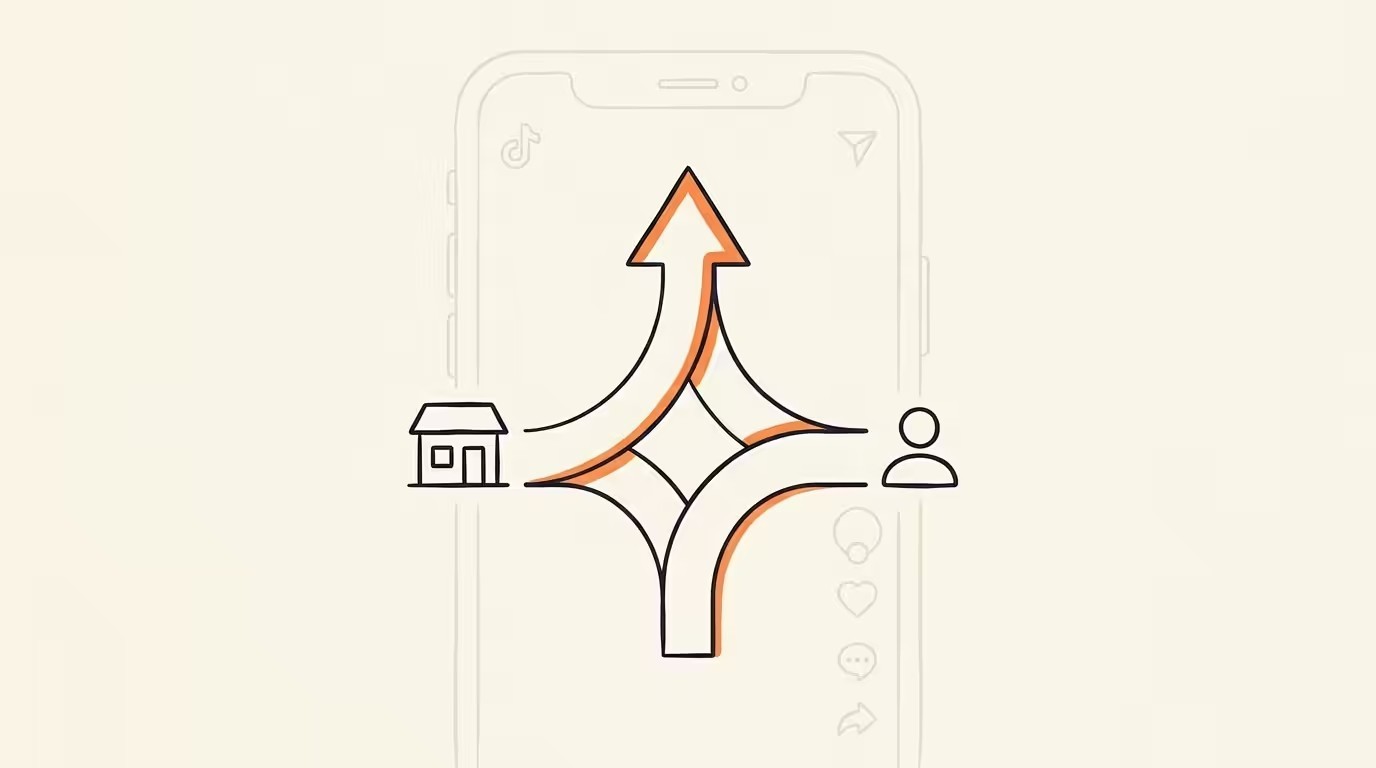
TikTok Smart+, introduced with the performance-automation suite unveiled at TikTok World in May 2024 and expanded substantially through 2025, is a fully automated campaign type. It consolidates three things that previously required separate decisions: who to target (audience selection), how much to bid (cost-per-result optimisation), and which creative to serve (choosing from your asset library in real time). You set a budget, choose an objective, upload your creative set, and the system runs the optimisation loop without further input. TikTok documents the campaign structure requirements in the Smart+ section of its Business Help Center.
Four campaign subtypes exist under the Smart+ umbrella. Web campaigns drive users to a landing page or website. App campaigns optimise for installs or in-app events. Lead Generation campaigns collect contact details without a user leaving TikTok. Shop campaigns, the most SEA-native variant, connect to TikTok Shop product catalogues and optimise for in-app purchases. The algorithm powering all four draws on TikTok's interest-graph and on-platform behavioural data, which is structurally different from Meta's social-graph signals. TikTok knows what content users watch and engage with; Meta knows who their friends are. Both are useful. They are not the same thing.
For a detailed breakdown of how each Smart+ campaign type works technically, see the companion post: TikTok Smart+ campaigns: how AI-automated targeting, bidding, and creative works in 2026.
What the automation covers
Targeting selection, bid management, creative rotation, placement decisions, frequency capping, and budget pacing are all handled inside Smart+. The advertiser controls the budget envelope, the objective, and the creative pool. Everything else is the machine's call.
What the machine still cannot decide
Once you understand what Smart+ does, the remaining human work becomes visible. It splits into four areas.
Creative strategy. Smart+ picks the winner from your pool of assets. It does not write the brief, decide what product angle to test, or determine whether a hook built for a Singapore audience will land differently in Melbourne or Toronto. The quality of creative inputs directly caps the quality of Smart+ output. A weak creative set will be optimised by the machine toward whichever weak asset is least bad. That is not the same as a good result.
Budget architecture. Smart+ optimises within the campaign constraints you set. It does not decide how much of your overall budget should go to TikTok versus Meta versus Google, or how to structure spend across funnel stages, markets, and objectives. Those decisions sit above the campaign layer and require someone who can see the full media mix.
Measurement design. Smart+ reports conversions against the objective you set. Those numbers include users who would have converted anyway through organic intent, brand search, or return visits. Deciding which conversion event to use, how to run an incrementality test, and whether the reported cost per acquisition (CPA) reflects genuine new revenue are judgment calls. The platform does not make them for you.
Account governance and compliance. Pixel health, product catalogue quality, ad category approvals for regulated verticals, policy-sensitive creative copy, and market-specific legal requirements are all outside Smart+'s scope. In financial services and insurance advertising across Singapore, Australia, the US, Canada, and Malaysia, the compliance brief is often more complex than the campaign brief. Smart+ does not read the regulatory handbook.
Decision flowchart: agency, consultancy, or in-house?
Use this to identify which model fits your current situation. The flowchart assumes Smart+ is available and technically viable for your objective. It focuses on where human input is most needed.
A few notes on how to read this. "Tactical management" means the day-to-day work of building campaigns, setting audiences, adjusting bids, and rotating creatives. In the Smart+ era, much of that is automated. If that is the primary value a vendor offers, it is the right question to ask whether you are paying for something the platform now does free. "Strategic direction" means creative brief ownership, measurement architecture, budget allocation across channels, and market-specific judgment. That is not automated.
When Smart+ is the wrong tool
Smart+ is not appropriate for every TikTok advertising situation. Knowing when not to use it is as important as knowing how to use it well.
- Low conversion volume. Smart+ requires a minimum signal threshold to optimise. If your campaign generates fewer than roughly 50 conversions per week within the campaign, the algorithm does not have enough data to learn. Manual campaigns with broader audience parameters perform better in these conditions.
- Regulated ad categories. Financial services, insurance, healthcare, and alcohol advertisers in many markets require prior ad category approval. Smart+ campaigns are available post-approval, but the compliance layers (disclaimers, approved landing pages, market-specific rules) sit outside the automation. In Singapore's MAS-regulated advertising environment and Australia's ASIC advertising context, these requirements are non-trivial. The platform does not manage them for you.
- Precise audience control requirements. Smart+ surrenders targeting control to the algorithm. For B2B advertisers who need to target by company, seniority, or job function, or for brands with active exclusion lists (existing customers, competitor lookalikes to avoid), manual campaign types offer more control. TikTok's audience targeting options are not as granular as LinkedIn's professional graph for B2B purposes.
- Brand-building and sequential messaging. Smart+ optimises for the conversion event you specify. It does not manage creative sequencing (serving awareness content before conversion content), brand frequency caps, or upper-funnel reach objectives with the same granularity as manual placements. For full-funnel strategies, a hybrid approach, Smart+ for direct response and manual campaigns for brand, tends to outperform either in isolation.
- New accounts with no pixel history. Smart+ learns faster on accounts with established pixel data. A new TikTok Ads account without conversion history will take longer for Smart+ to exit the learning phase. Running manual campaigns first to seed conversion data, then introducing Smart+, is a common and effective sequencing approach.
How the answer changes across SG, US, CA, AU, MY
Smart+ operates on the same algorithm globally, but the operating context differs enough that the strategic answer is not identical across leapbuzz's five primary markets.
| Market | TikTok maturity | Key Smart+ consideration |
|---|---|---|
| Singapore (SG) | High penetration, SEA commerce leader | TikTok Shop most mature; Smart+ Shop campaigns have the most history; MAS financial-ad category rules apply |
| Malaysia (MY) | High penetration, younger demographic skew | Strong SEA commerce; lower CPM competition than SG; BNM-regulated financial categories require approval |
| Australia (AU) | Growing, strong Gen Z and Millennial penetration | ASIC financial advertising rules; TikTok Shop less mature than SEA; higher CPM competition; incrementality testing more critical |
| United States (US) | High user base, regulatory uncertainty in 2025-26 | PAFACA (the Protecting Americans from Foreign Adversary Controlled Applications Act) injunction creates continuity risk; highest CPM; most conversion data available for Smart+ learning |
| Canada (CA) | Solid penetration, influenced by US market dynamics | Lower CPM than US; bilingual creative requirements for Quebec market; financial categories regulated by CIRO and provincial securities commissions apply |
US regulatory note
The US legislative situation around TikTok's ownership structure remained under active injunction as of early 2026. PAFACA (Protecting Americans from Foreign Adversary Controlled Applications Act), signed April 2024 with a January 2025 compliance deadline, required a divestiture. Court proceedings and an executive-order extension created a continuity window, but the structural uncertainty is a real business-continuity consideration for US-market advertisers building significant budget dependency on TikTok. This is not a reason to avoid TikTok; it is a reason to maintain portfolio diversification across platforms and not let any single channel exceed a threshold your business can absorb if access changes. The situation should be monitored at congress.gov.
The SEA angle is worth dwelling on for Singapore and Malaysia-based advertisers in particular. TikTok's interest-graph in SEA has been trained on a user base that adopted TikTok Shop significantly earlier than Western markets. Commerce intent signals are richer, product discovery behaviour is more native to the platform, and Smart+ Shop campaigns have more historical optimisation data to draw on. For e-commerce and retail brands in SG and MY, Smart+ Shop is often the strongest starting point for direct-response TikTok spend.
What Smart+ needs from your creative team
Smart+ is only as good as the creative pool it draws from. This is the most common point where advertisers underinvest and then blame the algorithm for underperformance.
TikTok's guidance for Smart+ campaigns recommends a minimum of five to ten creative variants. In practice, this means different hooks (the first three seconds of a video, which TikTok's own research identifies as the make-or-break moment for watch-through), different product angles, different formats (In-Feed video, TopView, Spark Ads from creator content), and different calls to action. The algorithm picks the winner from your pool and rotates aggressively. If your pool has three similar assets, the machine has very little to work with.
Spark Ads, which amplify organic TikTok content from your own account or from partnered creators, tend to perform well inside Smart+ because they carry native social proof (likes, comments, shares visible on the post). This is a creative strategy decision, not an algorithmic one. Someone needs to decide which creator posts to amplify, which organic content to boost, and whether the brand voice is consistent across paid and organic placements.
The creative brief is still human work
Smart+ chooses between your assets in real time. It does not write the brief, direct the shoot, edit the video, or decide whether a hook about price comparison will land differently with a 22-year-old in Kuala Lumpur than with a 34-year-old in Sydney. The creative brief is the single highest-impact input into a Smart+ campaign, and it is entirely outside the automation.
One practical implication: if you are evaluating a TikTok marketing company, ask how they structure the creative production process. A partner who cannot speak to hook strategy, format mix, and Spark Ads integration is managing the automation layer without understanding what feeds it.
Measuring whether Smart+ results are actually incremental
Smart+ will show you a cost per result. That number is real in the narrow sense that it reflects actual conversions attributed to Smart+ by TikTok's attribution model. It is not automatically a measure of what Smart+ caused.
Attribution in any platform, including TikTok, counts conversions within the attribution window (TikTok's default is 7-day click, 1-day view). Some fraction of those users would have converted anyway through organic search, a direct visit, or a return purchase. The platform-reported CPA (cost per acquisition) does not separate those users from the ones Smart+ genuinely brought in. This gap between reported and incremental performance is not unique to TikTok; it exists on every walled-garden platform. In markets with high TikTok organic reach, specifically SEA, the gap can be larger because platform-touch baseline is higher.
Incrementality testing closes the gap. A geo-holdout test withholds TikTok spend from one region while running it in a matched control region; the difference in conversion rate measures lift. TikTok's own measurement ecosystem supports brand lift and conversion lift studies through its measurement partners. The setup requires someone who understands experimental design and can interpret the results honestly, including when the results suggest Smart+ is contributing less incremental revenue than the reported CPA implies.
This is one of the clearest differentiators between a TikTok marketing company that operates at strategy level and one that manages campaigns. Reporting CPA from the dashboard is easy. Designing and reading an incrementality study is not.
Questions to ask any TikTok marketing company before hiring
Five questions that separate strategic partners from dashboard managers in the Smart+ era:
- How do you decide whether to use Smart+ or a manual campaign type for a given objective? A good answer names specific conditions (conversion volume, audience control needs, funnel stage). A weak answer says "Smart+ is always best" or "we prefer manual for control."
- What conversion event do you recommend for our objective, and why? The choice of conversion event is one of the most consequential inputs into Smart+. Different events (add-to-cart vs purchase vs lead vs complete-registration) produce very different behaviour from the algorithm. The reasoning should be specific to your funnel and business model.
- How do you measure incrementality, not just reported ROAS? If the answer is "we look at the TikTok dashboard," that is a red flag. A credible answer describes a holdout structure, even a simple geographic one.
- What is your creative process for producing enough variants to feed Smart+ properly? Look for specifics: hook testing methodology, Spark Ads integration, format mix decisions. Vague answers about "great content" are not the same as a brief-to-production process.
- What does your reporting show that the TikTok Ads Manager dashboard does not? The dashboard shows platform-attributed performance. A partner should add attribution-adjusted analysis, cross-channel context, and a view of what Smart+ is actually contributing versus the baseline.
For a broader guide on choosing the right digital marketing partner, the post How to choose a digital marketing company in 2026 covers the full evaluation framework across channels. For the technical mechanics of Smart+ campaign types specifically, see the companion post TikTok Smart+ campaigns: how AI-automated targeting, bidding, and creative works in 2026.
The leapbuzz TikTok Ads page describes how we structure TikTok engagements across the five markets in practice, including the paid social service layer that sits above the platform automation. The paid social service page covers how TikTok fits into a multi-platform paid social discipline alongside Meta, LinkedIn, and Reddit.