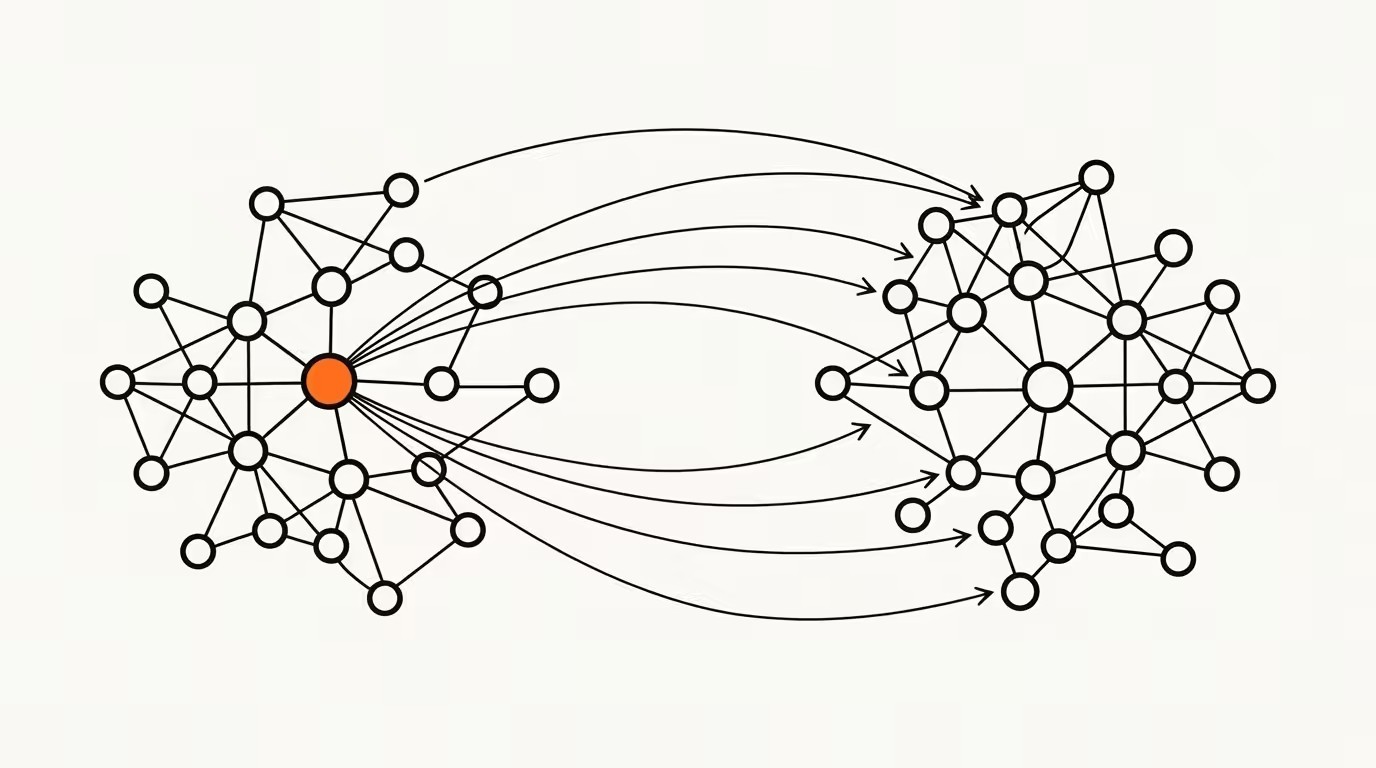
What Advantage+ automates vs what still needs humans
Advantage+ is Meta's umbrella term for AI-driven campaign types across Shopping, App, Lead, and Catalog surfaces. The core mechanic is the same across all of them: you provide the budget, the conversion objective, and the creative assets; the algorithm selects audiences, places ads across Facebook and Instagram inventory, sets bids, and ranks creative delivery without requiring manual audience sets or placement specifications.
That is a genuine shift from where the platform stood in 2020, when manual interest targeting and placement selection were the primary levers a practitioner turned. Those levers are still available, but Meta's own published performance data and the broader practitioner consensus both point toward Advantage+ as the more efficient starting point for most performance campaigns.
The comparison table below is the practical reference. It lists the specific decisions that Advantage+ handles automatically, the ones where a human partner adds value, and the ones where getting it wrong at the setup stage degrades everything downstream.
| Decision layer | Advantage+ handles it | Human partner owns it | Why it matters |
|---|---|---|---|
| Audience selection | Yes. Broad targeting with AI expanding dynamically across the full Facebook + Instagram addressable population. | No. Manual audience restrictions reduce the algorithm's optimisation surface. | Over-constraining audiences is the most common mistake partners make when onboarding to Advantage+. |
| Placement selection | Yes. Advantage+ distributes across Feed, Reels, Stories, Marketplace, and Audience Network automatically. | Brand-safety exclusions only (Audience Network opt-out is legitimate for some verticals). | Placement exclusions must be deliberate; default broad placement is the correct starting point. |
| Bid optimisation | Yes. Meta's auction model sets bids dynamically toward the declared conversion objective. | Choosing the correct conversion objective. The algorithm optimises toward whatever event you declare. | Optimising toward "add to cart" when you need "purchase" is a human error the algorithm will faithfully execute at scale. |
| Creative ranking and delivery | Yes. Advantage+ ranks and allocates budget across creative assets in real time. | Writing the creative brief. Producing the asset pool. Refreshing creative when fatigue sets in. | The algorithm ranks what you give it. A weak asset pool produces a weak best-performer. |
| Signal pipeline (CAPI + Pixel) | No. Meta requires the advertiser or partner to set up the Conversions API correctly. | CAPI implementation, deduplication, and Event Match Quality (EMQ) maintenance above 7.0. | Low EMQ means the algorithm trains on incomplete data. This is the single most common technical failure point. |
| Conversion event hierarchy | No. Aggregated Event Measurement (AEM) requires the advertiser to declare and prioritise up to 8 events per domain. | AEM event configuration, prioritisation, and iOS-specific reporting reconciliation. | Incorrect AEM means iOS conversion data is missing from reporting and optimisation. |
| Incrementality measurement | No. Meta's in-platform attribution is last-click and platform-biased by design. | Independent incrementality tests (Meta Conversion Lift, or MMM, or geo holdout). | Without independent measurement, you cannot tell whether Advantage+ is driving incremental sales or claiming credit for organic behaviour. |
| Board-level attribution reporting | No. | Translating in-platform metrics to CFO-legible reporting: incremental ROAS, payback period, contribution margin. | Finance teams do not accept platform-reported ROAS without cross-referencing to CRM or revenue data. |
| Policy compliance for regulated verticals | No. Meta's ad policies require the advertiser to categorise campaigns correctly (Special Ad Categories for credit, housing, employment, social issues). | Special Ad Category declarations, financial-service advertiser verification, and market-specific policy checks. | Non-compliant campaigns are disapproved or limited. In regulated markets (SG, AU, CA), policy failures can delay launches by weeks. |
The pattern that emerges: Advantage+ is strongest in the middle of the funnel, where real-time signal processing gives it an edge over any human practitioner. It is weakest at the edges: setup quality before the campaign runs and independent verification after it does. Those are the two zones where a skilled partner earns their position.
Signal quality is the real lever: CAPI, EMQ, and AEM explained
Advantage+ optimises toward whatever conversion signal it receives. If the signal is noisy, incomplete, or misconfigured, the algorithm trains on noise. Three concepts govern signal quality on Meta, and a partner's fluency with all three is a reliable proxy for their technical depth.
Conversions API (CAPI) is Meta's server-to-server event API. Rather than relying solely on the browser-side Pixel, which Apple's App Tracking Transparency (ATT) opt-in prompt blocks for a significant fraction of iOS users, CAPI sends purchase, lead, and custom events directly from the advertiser's server. The Pixel and CAPI run in parallel, with deduplication logic preventing the same event from being counted twice. A correctly implemented CAPI raises EMQ and ensures the algorithm sees the full conversion universe, not just the browser-observable fraction.
Event Match Quality (EMQ) is Meta's 0-10 score measuring how well the events sent via Pixel and CAPI can be matched to real user identities. The matching uses hashed identifiers: email address, phone number, client IP address, and user agent at minimum. EMQ of 6.0 is acceptable. EMQ of 7.0 or above is the target for any account running Advantage+. Below 6.0, a meaningful share of conversion events cannot be attributed to a user, and the algorithm's training data degrades proportionally.
Aggregated Event Measurement (AEM) is Meta's iOS-friendly conversion-reporting layer. It imposes an 8-events-per-domain cap. Advertisers must declare and prioritise which conversion events matter, from purchase down to page view, before AEM kicks in. Events outside the declared set do not report for iOS users. For a single-product ecommerce account this is rarely a problem. For a complex lead-generation account with multiple form types, or a financial-services account tracking quote requests, application starts, and completions, the prioritisation decision requires deliberate thought. Partners who have not configured AEM correctly often do not know they are missing iOS conversion data, because the data gap is silent.
The combined picture: CAPI feeds signal into Meta. EMQ tells you how much of that signal is usable. AEM determines which events Meta uses to train Advantage+ for iOS-originated traffic. A partner who can describe their approach to all three, with specifics, understands the platform at the level that matters for 2026.
For a deeper reference on how Meta benchmarks these signals across categories and markets, see the cost-per-bound policy Meta benchmarks post.
Creative strategy is not creative production
Advantage+ ranks and allocates delivery budget across the asset pool you provide. It does not generate the brief that drives what goes into that pool. Creative quality, which here means creative that changes consumer behaviour rather than just creative that renders correctly, determines the ceiling the algorithm can reach. A weak brief produces a weak asset pool, and the best-ranked asset in a weak pool is still weak.
The distinction between creative strategy and creative production is where a lot of partnerships fail. Production means making assets: video cuts, static frames, carousel cards. Strategy means deciding what to say to whom at what stage of the purchase decision, then briefing the creative team with enough specificity that the production output is testable. A creative brief that says "show product benefits in a native-feel video" is production direction. A brief that says "the primary objection at the consideration stage is price, and the counter-argument is total cost of ownership over 12 months; the format should feel like a founder talking directly to camera, not a polished ad" is strategy.
Creative fatigue is the second dimension. Advantage+ automatically deprioritises lower-performing assets as frequency rises. But it does not commission new creative when the entire pool fatigues. That is a human decision, and it requires a refresh cadence. The practitioner benchmark in most consumer categories is a creative review every two to three weeks, with new assets ready before performance metrics signal fatigue, not after. Lagging indicator creative refreshes mean you are already spending on degraded creative by the time you react.
In 2026, the creative question has a third layer: AI-generated assets. Meta's generative AI tools, available in Ads Manager, can generate background variations, expand images, and produce text variations from a seed. Third-party AI image and copy tools are also widely used. Advantage+ will distribute AI-generated creative alongside human-produced creative without distinction in delivery. The distinction appears in Meta's AI labelling system, which as of June 2026 applies "AI info" labels to both Meta-generated and third-party AI-generated ads via the "About this ad" menu. Partners running AI-generated creative in your account should tell you which assets carry the label, and your brand guidelines should have a position on this before the campaign launches.
The Meta platform page covers the full creative format matrix across Facebook and Instagram placements.
Meta Business Agent and the full-funnel picture
On June 3, 2026, Meta announced and began global expansion of Meta Business Agent, an AI that handles customer enquiries, product recommendations from a business catalogue, lead qualification, appointment booking, and in some cases direct sales. The announcement cited more than one million businesses already using a Business Agent on WhatsApp and Messenger before global rollout, with more than one billion active threads between people and businesses on WhatsApp, Messenger, and Instagram each day. Meta newsroom, June 3 2026.
The relevance to partner selection is direct. Meta Ads increasingly function as the top-of-funnel entry point into a conversational AI experience. An Advantage+ campaign drives a click; the click lands in a WhatsApp thread where a Business Agent takes over. The creative and offer logic in the ad, and the response logic in the Business Agent, need to be coherent. A partner who manages only the ad manager side of this without visibility into or influence over the conversational experience is managing half the funnel.
This matters more in markets where messaging is the primary purchase channel. In Singapore, Malaysia, and much of Southeast Asia, WhatsApp is a standard business communication tool. In Australia and Canada, it is less dominant but growing for B2B enquiry handling. In the United States, the Meta AI ecosystem is primarily Facebook Messenger and Instagram DMs. A partner operating across multiple markets for you should understand which surfaces the Business Agent activates in each market.
The agentic shift on Meta is part of a broader platform move described in the agentic marketing operations post. Partners who have not thought through the ad-to-agent pipeline are operating with a 2023 mental model of what Meta campaigns do.
Meta AI disclosure: what your partner needs to know
Meta has built an AI labelling system for ads. Originally published February 3, 2025, and updated June 1, 2026 to reflect product changes, the system now applies "AI info" labels via an "About this ad" menu on every ad on Meta's platforms. The label appears when: (1) an image or video was created or significantly edited using Meta's own generative AI creative tools; or (2) Meta's automatic detection identifies that the ad was created or edited with a third-party AI tool, using industry-standard signals. Meta newsroom, updated June 1 2026.
What this means operationally for advertisers running in 2026:
- If your partner uses Meta's generative AI tools (background generation, image expansion, text variations in Ads Manager), the resulting ads will carry the "AI info" label.
- If your partner uses third-party AI tools (external image generation, AI copy tools) and the resulting creative is uploaded to Meta, Meta will attempt to detect and label it automatically based on embedded signals.
- If your brand guidelines require prior notification before AI labelling applies to your ads, your partner needs to flag AI-assisted creative before it goes live.
- The label is informational, not a compliance penalty: it appears in the "About this ad" menu, not as a banner on the ad itself. However, for regulated-sector advertisers in financial services or insurance in Singapore, Australia, Canada, and the United States, the presence of AI labels may interact with sector-specific ad policies that require accuracy and non-deception standards.
The practical question for partner evaluation is not whether AI-generated creative is acceptable (it generally is). The question is whether your partner has a documented process for knowing when the label will apply and for informing you before deployment.
In-house vs agency vs AI-native consultancy: when each model fits
Three management approaches exist for running Meta Ads. Each is correct in specific circumstances and wrong in others. The Advantage+ era shifts which approach fits which situation.
| Dimension | In-house | Traditional agency | AI-native consultancy |
|---|---|---|---|
| Best fit | High creative volume, real-time offer changes, deeply brand-embedded decisions | Execution scale with well-defined briefs, lower strategic complexity | Multi-market complexity, CAPI/measurement build, regulated vertical, board-level attribution |
| Advantage+ setup quality | Depends entirely on the individual hire | Variable; large agencies have specialists but junior resource often runs execution | Senior practitioner on setup; the model relies on fewer people running larger accounts |
| CAPI and signal pipeline | Requires a developer resource or GA4/GTM expertise in-house | Often outsourced to a tag management team; quality varies | Core deliverable; typically includes implementation plan and ongoing EMQ monitoring |
| Creative strategy | Strongest: product team, brand team, and media all in the same building | Creative team may be separate from the media team; brief-to-execution handoff loses nuance | Partner-led brief; production outsourced; consultant owns the hypothesis, not the production |
| Independent measurement | Requires separate investment; in-house teams often rely on platform reporting | Rarely offered proactively; incremental ROAS tests require separate engagement | Standard offering; the absence of platform-bias is a core positioning claim |
| Multi-market compliance | Difficult without a central compliance function | Network agencies have regional offices; independents may not | Depends on the consultancy's market coverage; ask specifically |
| Cost model | Fixed headcount cost; scales with the team, not the spend | Percentage of spend or flat retainer; often includes minimums | Project or retained advisory; not positioned against junior agency pricing |
The Advantage+ effect on this comparison: because the platform now handles what junior analysts used to spend hours doing (audience builds, placement testing, bid adjustments), the value of adding a junior-heavy agency team has compressed. What remains irreplaceable is senior judgment at setup, signal quality expertise, creative strategy, and independent measurement. Those skew toward either a strong in-house senior hire or a consultancy operating at that level.
leapbuzz operates as an AI-native consultancy across Singapore, Malaysia, Australia, the United States, and Canada. Our paid social work includes active campaign management for clients in regulated verticals including financial services and insurance. Travel Guard Singapore is our named live client in paid media. The paid social service page describes the engagement structure in detail.
Partner self-score: 10-point evaluation checklist
Use the checklist below when evaluating any Meta Ads partner. Each item maps to a question you can ask or a document you can request. The score is not a pass/fail; it is a conversation starter. Any item where a candidate cannot provide a clear answer is a gap worth probing.