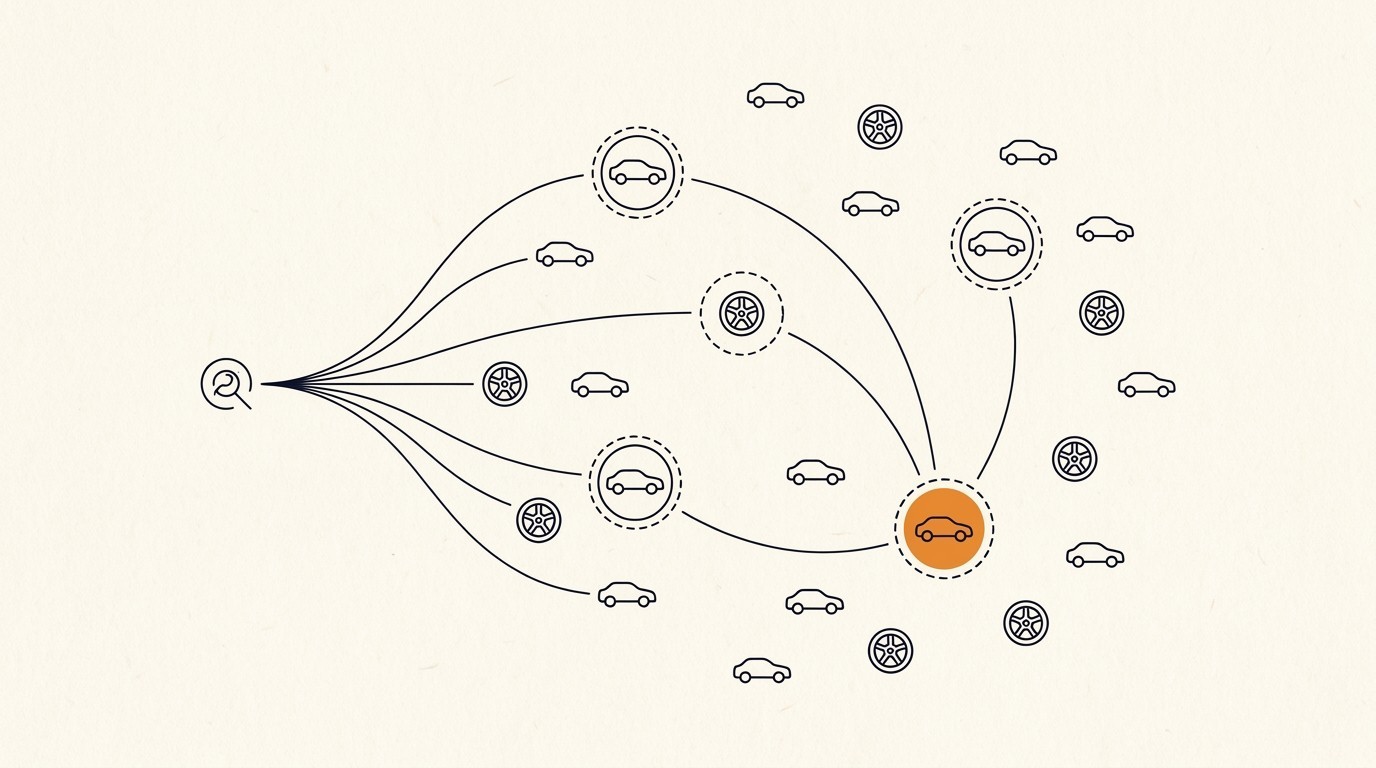
What the mid-funnel actually is in AI search
The mid-funnel is the comparison stage. A buyer has decided roughly what they want and is now narrowing where to buy or service it. In an AI engine that looks like a single typed question: best dealer group for a used Mazda in Perth, compare servicing plans for a three-year-old Volvo, or which dealer near me is most trusted for warranty work. These are not discovery questions and they are not booking questions. They are the questions that decide who makes the buyer's shortlist.
That stage is now a real channel, not a forecast. A meaningful and growing share of in-market vehicle shoppers now use AI tools during research, with ChatGPT the most common and Gemini close behind, and the prompts they run include explicit comparison-phase questions of the form brand A model X versus brand B model Y. For automotive teams across the markets we work in, Singapore, the United States, Canada, Australia, and Malaysia, that is the moment the dealer is either in the answer or invisible.
The reason the mid-funnel deserves its own attention is mechanical. Top-funnel questions get long, generous answers. Bottom-funnel questions usually hand off to a map result or a booking link. The mid-funnel is where the engine does the cruel work of cutting a long list down to a handful, and a handful is a much smaller number than the first page of Google.
How the engines build the shortlist
When a buyer asks a comparison question, the engine does not look up one page and read it back. It assembles an answer from many sources. Google AI Mode runs what Google calls a query fan-out: its custom Gemini model splits the question into 8 to 12 sub-queries, runs them in parallel, and synthesises the results, attaching citations to the specific spans they support. Google described this directly in its AI Mode update at Google I/O 2025.
So a single mid-funnel prompt about dealers can quietly become a dozen searches: one for reviews, one for servicing complaints, one for warranty experiences, one for pricing transparency, one for each named candidate. The engine then reconciles what those searches return and writes a shortlist. The sources that agree with each other win. The dealer described consistently across independent surfaces gets named; the dealer described only on its own website does not.
Which sources carry the weight is now observable across engines, and the pattern is consistent. Large-scale citation analyses repeatedly show the engines leaning on independent, consensus surfaces rather than brand-owned pages: community sites such as Reddit, encyclopedic entries, review platforms, and video. ChatGPT skews toward established entity presence, Perplexity and Google AI Overviews lean harder on community and review signal, and Google AI Mode fans out across reviews, forums, manufacturer pages, and aggregators. The common thread is that owned-only content is the source the engines trust least.
For automotive specifically, the Spike Automotive study found Gemini drawing its dealer assessments from reviews, forum posts, social content, manufacturer ecosystems, and aggregators such as Carwow and Autotrader. None of those is the dealer's own site. That is the single most important fact in this article, so it gets its own sentence: the engine cites the places that talk about you, not the place you talk about yourself.
Why dealer groups vanish at the shortlist stage
Dealers vanish at the mid-funnel because the shortlist is short and the entry criteria are not the ones they optimised for. The Spike Automotive study reported in Car Dealer Magazine in March 2026 ran 5,000 Gemini queries across 10 car models, 10 UK cities, and 5 buying themes. It produced 18,746 dealer mentions from 1,214 unique sources, and the distribution was savage.
| Measure | Figure | Read |
|---|---|---|
| Dealers named per response | About 3.75 | The shortlist is tiny; most dealers never appear |
| Mention share of top six groups | Over 31 percent | A handful of groups absorb most visibility |
| Average mentions for the other 1,694 dealers | Fewer than 8 each | The long tail is close to invisible |
| Unique sources behind the mentions | 1,214 | Many independent surfaces feed one answer |
Three things cause a dealer group to fall out of that shortlist. First, thin third-party description: if no review site, forum, or aggregator describes the dealer for the thing being compared, the engine has nothing to cite. Second, inconsistent identity: different names, addresses, or claims across surfaces make the engine less confident, and low confidence reads as omission. Third, owned-only content: a beautiful dealer website with no independent corroboration is exactly the source the engine trusts least.
Reading benchmarks built on UK Gemini data needs care. The exact percentages are market and engine specific, and they will differ in Sydney or Singapore. The mechanic does not differ. A small shortlist assembled from third-party agreement is how every major engine handles a mid-funnel dealer comparison, and that is the part worth acting on.
What the named-brand prompt actually teaches
One of the more revealing things in our own demand data is a query buyers and practitioners keep running: an instruction to evaluate a specific, well-known dealer group on mid-funnel prompts. Names like Arnold Clark show up inside that pattern. It is worth being precise about why people run it, because the answer is not what it looks like.
The named brand is a probe, not the subject. We make no claim about any particular dealer group here, and the value of the exercise has nothing to do with a verdict on the company in the prompt. A recognisable national group is simply a useful benchmark: it almost certainly appears in the answer, which means it reveals what the engine treats as a strong mid-funnel signal. Run the prompt, then read the citations rather than the prose. The citations tell you which review platform, which forum thread, which aggregator profile the engine reached for. That list is your target list.
Reading the citations, not the verdict
This is where the mention-source divide becomes operational. The engine recommends a brand, the mention, but the link it attaches usually points at a third party, the source. Your competitor gets the recommendation; a review page gets the click. If you want to change who gets recommended, you change what those cited third-party surfaces say, because that is the layer the engine actually reads.
The takeaway from running the probe is the same brutal arithmetic the concentration data already showed: Gemini named only about 3.75 dealers per mid-funnel response, and six groups took over 31 percent of all mentions. So the named-brand prompt is not there to rank the famous group. It is there to show you, on a name that is guaranteed to clear that 3.75-deep shortlist, exactly which third-party surfaces earned the slot, so you can go and earn the same ones.
How to audit your mid-funnel AI visibility
An audit turns this from theory into a worklist. The method is the same one we use inside AI visibility optimisation for any sector, tuned for automotive intent. It runs in five steps.
- Build the prompt set. Write 20 to 40 mid-funnel prompts a real buyer would type: dealer comparisons, servicing-plan comparisons, aftersales and warranty trust questions, and finance or trade-in questions, each grounded in your actual models and cities.
- Run them across four engines. Put every prompt through ChatGPT, Gemini, Perplexity, and Google AI Mode. Answers vary between engines and between runs, so run each prompt more than once.
- Log presence, competitors, and citation. For each result record whether you appear, which rivals appear, and which third-party source got the citation link. The third column is the one most teams skip and the one that matters most.
- Map the cited surfaces. Collapse the citations into a ranked list of the review sites, forums, and aggregators the engines actually read for your prompts. This is where the work goes.
- Re-run on a cadence. Repeat the same prompt set monthly or quarterly so citation share is a tracked metric, not a one-time screenshot. This is exactly the discipline we describe in our end-to-end GEO playbook and our AI Mode marketing playbook.
The structuring work that follows the audit splits across a few leapbuzz services. The owned-data side, machine-readable service and pricing information, clean local business data, structured aftersales pages, sits with website development and analytics and insights. The decision side, which prompts to defend, which markets to prioritise, how AI visibility fits the wider plan, is AI marketing strategy work. The citation-surface side, the reviews, forums, and aggregators the engines cite, is core visibility optimisation. The point is that a mid-funnel fix is rarely one task; it is owned data, third-party signal, and measurement moving together.
If you want to see how this lands in revenue rather than rankings, our anonymised results show the same audit-then-fix discipline applied across regulated and high-stakes sectors. The automotive version is the same operating logic pointed at dealer and aftersales intent.
Where an independent dealer can still win
The headline numbers favour the big groups, but the most useful finding in the Spike Automotive study points the other way. Aftersales was the most diverse category, with 614 unique dealers mentioned, far more than the six groups that dominate new-car answers. The shortlist for compare servicing plans or who is trusted for warranty work is wider, more local, and more contestable than the shortlist for buy a new car.
That is the opening. Servicing and aftersales prompts are answered by local review and forum signal, the exact signal an independent can build without a national media budget. A single-site dealer that earns consistent, recent service reviews, publishes structured and honest service information, and shows up correctly on the major aggregators can land in the shortlist for the questions the big groups treat as an afterthought.
- Win the review surfaces first. Recent, specific service reviews on the platforms the engines cite move you faster than any owned page, because corroboration is what the engine trusts.
- Make your aftersales machine-readable. Structured service, pricing, and warranty information gives the engine clean facts to lift into a comparison answer.
- Fix identity consistency. One name, one address, one set of claims across every surface raises the engine's confidence, and confidence is what gets you named.
- Defend the consultant query. Buyers searching for AI consultants for automotive marketing are looking for exactly this work; being described clearly for it on third-party surfaces is part of the same discipline you are auditing.
The buyers are already asking. A substantial share of shoppers now using AI in research, ChatGPT the most common engine among them, and a shortlist of fewer than four dealers per answer add up to one conclusion: mid-funnel AI visibility is now a line item, and for the long tail of dealers, aftersales is the most winnable line on it. For carmakers and dealer groups specifically, the automotive practice at leapbuzz is built around exactly this work.